

There was a time when building your first gaming PC felt almost like a rite of passage.
You compared processors, searched for the graphics card offering the best value for money, saved a little on the case to invest in more RAM, and then proudly assembled a machine capable of running the latest games.
The result wasn’t necessarily spectacular. Sometimes the fans sounded like a jet taking off, the cables resembled an experimental physics project, and that first boot could be a nerve-racking experience.
But the important thing was that, with a reasonable budget, some patience, and a little knowledge, you could enjoy an excellent gaming experience.
That promise hasn’t completely disappeared.
And yet, something has changed.
High-end graphics cards now cost what entire computers once did. Memory and storage have become strategic markets for artificial intelligence infrastructure. Manufacturers are increasingly relying on technologies designed to enhance perceived performance, while some games demand ever-greater hardware resources.
And amid this transformation, one question is beginning to emerge: is the average PC gamer still at the center of the computing industry’s priorities?
When a Graphics Card Costs as Much as an Entire Computer
The most visible symbol of this transformation is the graphics card, which has become a gaming component, a computing accelerator, and a symbol of technological prestige all at once.
For a long time, the graphics card was already the most expensive component in a gaming PC. But recent developments have widened the gap between different product categories.
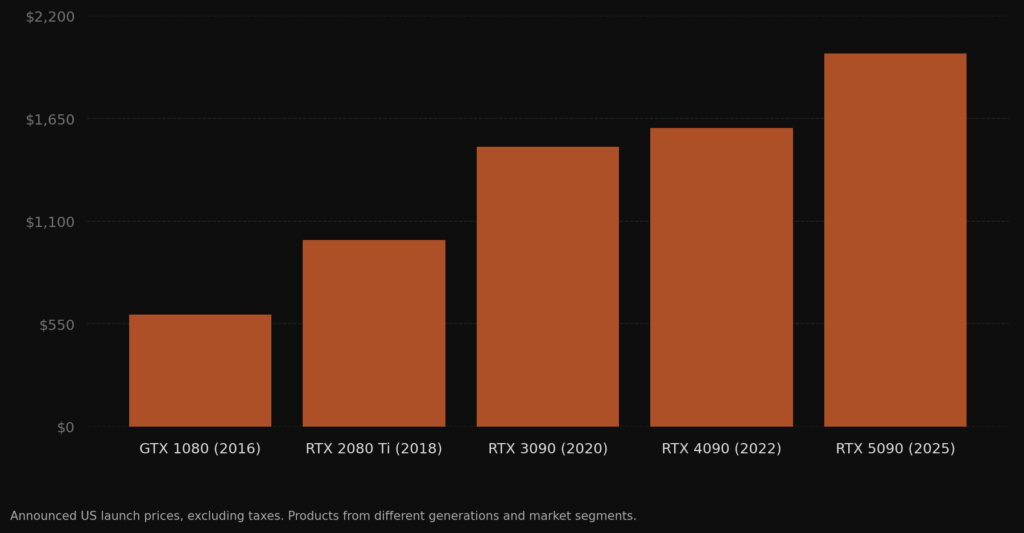
NVIDIA’s launch of the GeForce RTX 5090, with an announced US starting price of $1,999, illustrates this evolution. Of course, this is a model designed for the most demanding users, not a product representative of the market as a whole.
Nevertheless, its positioning demonstrates just how far the high-end segment has moved away from the traditional notion of consumer hardware.
US Launch Prices of Selected NVIDIA Graphics Cards
It would be misleading, however, to conclude that all graphics cards have become unaffordable.
Mid-range products still exist. AMD, NVIDIA, and Intel continue to offer more affordable solutions, while previous-generation hardware can still deliver excellent performance.
The problem lies elsewhere: improvements in performance, new graphics features, and manufacturers’ pricing strategies are making it increasingly difficult to identify the best value for money.
In the past, buying a mid-range graphics card was often a relatively straightforward compromise.
Today, buyers must compare traditional rendering performance, video memory capacity, ray tracing capabilities, image reconstruction technologies, power consumption, and sometimes even frame generation capabilities.
Choosing the right card has become more complicated, and purchasing mistakes can be more expensive.
Artificial Intelligence: The New Giant Disrupting the Market
To understand what’s happening, we need to look beyond PC gaming.
Since the rise of generative artificial intelligence, major technology companies have been investing heavily in data centers capable of training and running increasingly powerful AI models.
These facilities require specialized processors, graphics accelerators, memory, and storage systems.
Some of these resources depend on the same industrial supply chains used to manufacture components for personal computers.
That doesn’t mean gaming graphics cards and data center accelerators are identical. They often use very different architectures, memory configurations, and components.
But they compete for certain manufacturing capacities, investment priorities, and, above all, commercial attention.
For manufacturers, enterprise customers represent enormous orders, often planned years in advance and potentially generating higher profit margins.
A gamer typically buys a graphics card every few years. A data center operator may order thousands of accelerators as part of a single investment program.
The balance of power is hardly the same.
This phenomenon is particularly visible in the memory market.
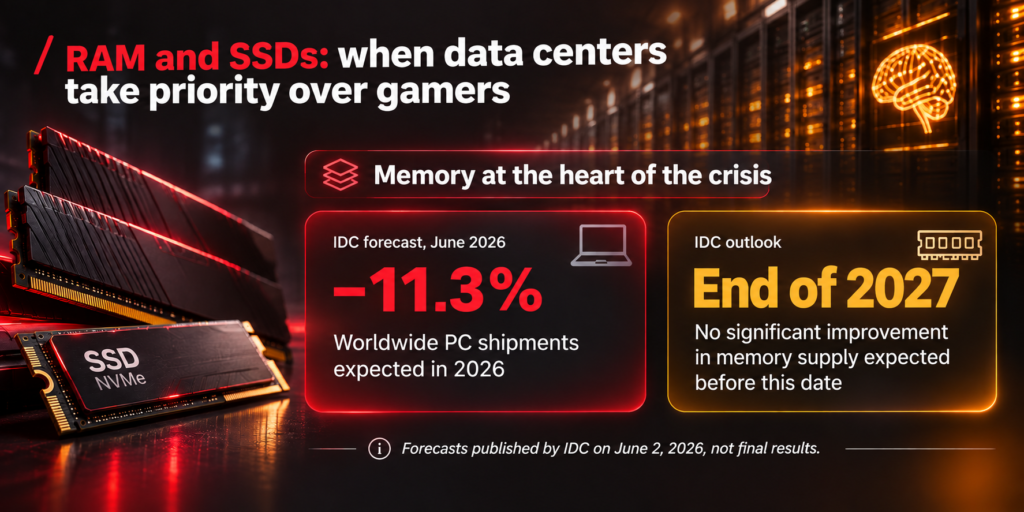
RAM and SSDs: When Data Centers Take Priority Over Gamers
Memory at the Heart of the Crisis
RAM allows computers to temporarily store information needed by running applications. SSDs, meanwhile, use NAND flash memory to permanently store games, software, and files.
Manufacturing these components depends on a relatively small number of major global producers.
With the rise of AI, some manufacturing capacity is being directed toward more profitable server-oriented products, particularly HBM, or High Bandwidth Memory.
This extremely high-bandwidth memory is essential for many artificial intelligence accelerators.
It isn’t interchangeable with the DDR5 RAM in your computer, but its development requires industrial resources and investment that can reduce the capacity available for other products.
In September 2026, TrendForce highlighted this shift in supply toward server memory and HBM, at the expense of certain consumer segments. The research firm also anticipated further increases in DRAM and NAND contract prices during the fourth quarter.
This situation directly affects gamers.
A configuration that previously required a reasonable investment in 32 GB of RAM and a high-capacity SSD can become noticeably more expensive, even without changing the processor or graphics card.
And unlike a high-end graphics card, memory and storage aren’t luxury components.
They’re essential to virtually every computer.
Has PC Gaming Become Collateral Damage in the AI Boom ?
It would be excessive to blame every price increase on artificial intelligence.
Inflation, energy costs, exchange rates, research and development expenses, commercial strategies, and fluctuations in supply also play a role.
However, AI introduces an important structural transformation: component manufacturers are no longer as dependent on the consumer market to drive their growth.
NVIDIA is a particularly telling example.
Historically associated with GeForce graphics cards, the company has become a central player in computing infrastructure for artificial intelligence.
Its gaming business remains important, but it now operates alongside an enterprise market with enormous financial and technological demands.
This doesn’t mean NVIDIA is abandoning gamers. The GeForce RTX 50 lineup, with its various price categories, demonstrates otherwise.
Rather, it means gaming is no longer necessarily the dominant force behind industrial decisions.
And when manufacturing capacity becomes constrained, the most profitable markets may receive priority.
That’s a major shift for a computing industry that developed for decades around the needs of consumers and traditional businesses.
Are Video Games Becoming Too Demanding ?
Rising component prices are only part of the problem.
The other part lies within the games themselves.
Over successive hardware generations, developers have sought to create increasingly detailed environments, more realistic lighting effects, more complex animations, and ever-larger open worlds.
These advances come at a technical cost.
High-resolution textures consume more video memory. Ray tracing effects require additional calculations. Complex open worlds place greater demands on processors, memory, and storage systems.
Some recent games now recommend hardware configurations that would have been considered exceptionally powerful just a few years ago.
But we need to distinguish between two different phenomena.
On one hand, graphical advances naturally introduce new hardware requirements.
On the other, software optimization sometimes leaves much to be desired.
A game that stutters on a powerful machine isn’t necessarily technologically revolutionary.
It may simply suffer from poor memory management, shader compilation issues, asset streaming problems, or inefficient CPU utilization.
Hardware power shouldn’t become an excuse for neglecting optimization.
Because continually demanding more from gamers without proportionally improving their experience effectively shifts part of the development burden onto consumers.
DLSS, FSR, and Frame Generation: Technological Progress or a New Dependency ?
To compensate for increasing graphics requirements, manufacturers have developed various image reconstruction technologies.
NVIDIA’s DLSS, AMD’s FSR, and Intel’s XeSS allow games, depending on the technology and version, to render images at a lower resolution before reconstructing them at a higher resolution.
The goal is to improve performance while maintaining satisfactory image quality.
These technologies are complemented by frame generation, which can increase the number of images displayed on screen by creating intermediate frames using information from the game engine and specialized algorithms.
The results can be impressive.
But these solutions raise a fundamental question: are games still being designed to run properly without them?
It’s important not to confuse three concepts: visual smoothness, the number of frames actually rendered by the game engine, and input responsiveness.
Frame generation can make motion appear smoother, but it doesn’t automatically reduce the time a game needs to process player input.
A display running at 120 frames per second through frame generation doesn’t necessarily offer the same responsiveness as native rendering at 120 frames per second.
These technologies represent genuine advances. They can even extend the useful lifespan of certain hardware configurations.
The risk emerges when they become an implicit requirement for acceptable performance.
Innovation should allow gamers to do more with their hardware, not simply hide the limitations of increasingly demanding games.
The Reality for Gamers: Full HD Is Still Going Strong
Despite all the marketing surrounding 4K, advanced ray tracing, and ultra-high-refresh-rate monitors, actual usage tells a different story.
According to Steam’s October 2026 Hardware Survey, the RTX 3060, RTX 4060, and RTX 5070 were among the most widely represented graphics cards.
Full HD, or 1920 × 1080 pixels, also remained the dominant resolution, accounting for roughly half of the surveyed configurations.
Steam Players’ Display Resolutions — October 2026
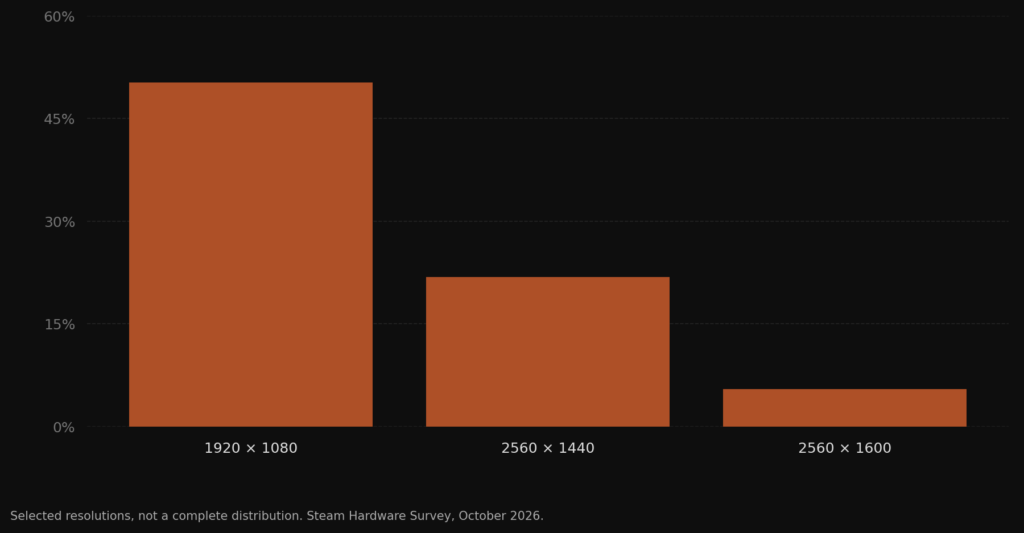
These figures highlight an obvious reality: most gamers aren’t necessarily trying to run every game in 4K with all graphics settings maxed out.
Many simply want to play comfortably at Full HD or 1440p, with smooth performance and satisfying visual quality.
For these players, component value for money remains essential.
And that’s precisely why developers have every reason not to treat high-end hardware as the norm.
A technically impressive game that’s inaccessible to a large portion of its potential audience risks limiting its own success.
The 8 GB VRAM Trap
Video memory capacity, or VRAM, has become one of the most contentious topics in the graphics card market.
This memory allows the GPU to quickly store textures, geometry information, and various data required for rendering.
When a game exceeds the available capacity, it may need to transfer more data from system memory or reduce the quality of the resources being used.
This can cause stuttering, delayed texture loading, or inconsistent performance.
However, claiming that 8 GB of VRAM is now universally insufficient would also be misleading.
It all depends on the game, resolution, texture quality, and enabled graphics technologies.
For Full HD gaming, an 8 GB card can still deliver a satisfactory experience in many titles.
However, for a new PC intended to last several years, particularly at 1440p, having 12 or 16 GB can provide valuable additional headroom.
Memory capacity isn’t everything, though. GPU processing power, memory bandwidth, and architecture remain decisive factors.
A graphics card equipped with 16 GB of VRAM isn’t automatically faster than a 12 GB model.
The real problem arises when consumers must choose between enough memory for future games and prices that exceed their budgets.
The Used Hardware Market: The Last Refuge of Affordable PC Gaming ?
Faced with rising prices for new components, many gamers are turning to secondhand hardware.
A previous-generation graphics card, a still-capable processor, or a DDR4-based platform can make it possible to build a system perfectly capable of running a large portion of the PC gaming catalog.
This strategy offers several advantages.
It reduces the initial investment, extends the lifespan of components, and helps limit electronic waste.
But it also carries risks.
A used graphics card may have experienced intensive use. An aging power supply can put other components at risk. Some older platforms offer limited upgrade options.
Warranty coverage, driver availability, and hardware features missing from older generations must also be considered.
The used market isn’t a miracle solution.
Nevertheless, it remains one of the most interesting ways to preserve affordable access to PC gaming.
And in an industry that regularly encourages hardware replacement, extending the life of a gaming PC can also become a form of economic resistance.
What Does an Affordable Gaming PC Look Like in 2026?
It’s worth asking this question in practical terms.
Rather than attempting to match the performance of machines featured in technology demonstrations, it makes more sense to establish realistic goals.
Three PC Configuration Tiers Worth Considering
| Budget | Gaming Goal | Approach |
|---|---|---|
| €600–€800 | Full HD, adjusted settings | Used parts, budget components, and compromises |
| €900–€1,200 | Comfortable Full HD, 1440p depending on the game | Well-balanced mid-range build |
| €1,300–€1,600 | 1440p with more performance headroom | More powerful GPU and appropriately sized memory |
Indicative budget ranges for the PC tower only. These are not quotes based on verified real-time retail prices.
These budgets can vary significantly depending on RAM, SSD, and graphics card prices at the time of purchase.
A monitor, peripherals, and an operating system may also need to be added.
Nevertheless, finding the best value for money still comes down to a few simple principles: prioritize a balanced configuration, avoid unnecessarily expensive components, don’t compromise on power supply quality, and define your actual needs before buying.
A computer intended for competitive Full HD gaming doesn’t need the same hardware as a workstation designed for 3D content creation and 4K gaming.
And there’s absolutely no obligation to replace your graphics card simply because a new generation has been announced.
Could Consoles Benefit From This Situation ?
Historically, consoles have enjoyed an important economic advantage: their hardware is built around a relatively standardized architecture and manufactured at scale.
This approach makes it possible to deliver a consistent experience without requiring players to select every component themselves.
Developers can also optimize their games for a limited number of hardware configurations.
If PC gaming costs continue to rise, this simplicity could become an even stronger selling point.
However, consoles aren’t immune to industrial pressures.
They also use semiconductors, memory, and storage. Their manufacturers therefore face some of the same economic constraints.
The difference lies more in control over the platform and its business model.
PC gaming, meanwhile, retains considerable advantages: configuration freedom, upgradability, versatility, access to an enormous game catalog, community-created modifications, and a wide range of digital storefronts.
The debate therefore isn’t simply about determining which platform is cheaper.
It’s also about the value of the freedom offered to players.
What Comes Next ? Three Scenarios for PC Gaming
The market’s future will largely depend on how demand for artificial intelligence evolves, how manufacturers invest in production capacity, and how competition develops.
Scenario 1 — The Market Finds Its Balance Again
Manufacturing capacity expands, memory supply pressures ease, and competition helps stabilize prices.
PC gaming remains accessible, even if certain premium segments continue to command high prices.
Scenario 2 — Mid-Range Becomes the New Luxury
Enterprise demand continues to absorb a significant share of industrial capacity.
New PC builds become more expensive, and gamers keep their existing hardware for longer.
Scenario 3 — The PC Gaming Business Model Evolves
Cloud gaming, hybrid devices, and more integrated hardware solutions gain ground.
Players gain new alternatives but may become increasingly dependent on subscriptions, network connections, and proprietary ecosystems.
These scenarios aren’t mutually exclusive.
The market could stabilize for certain components while prices remain high for others.
One thing seems likely, however: the coming years will force gamers to think more carefully about the lifespan and long-term value of their hardware investments.
Conclusion: Affordable PC Gaming Isn’t Dead, but Its Promise Is Under Pressure
PC gaming isn’t disappearing.
It remains one of the richest, most open, and most diverse gaming environments available.
It’s still possible to build a machine capable of running excellent games without spending several thousand dollars.
But the historical promise of affordable PC gaming is colliding with a profound transformation of the computing industry.
Artificial intelligence now attracts a considerable share of investment and manufacturing capacity. Component manufacturers are seeking to maximize their margins in rapidly expanding enterprise markets. Video games are becoming more demanding, while technologies designed to compensate for those demands occupy an increasingly prominent place in marketing campaigns.
The risk, then, isn’t that PC gaming will become exclusively reserved for the wealthy.
The risk is that gamers on modest budgets will gradually be forced to make more and more compromises to enjoy an experience that once seemed comfortably within reach.
And perhaps that’s where the real issue lies.
Because the future of PC gaming doesn’t depend solely on its ability to deliver ever more spectacular graphics.
It also depends on its ability to remain an open, accessible, and sufficiently affordable platform to welcome new generations of players.
PC gaming doesn’t need everyone to be able to afford a $2,000 graphics card. It needs to make sure nobody is forced to buy one just to keep playing.




Comments 0
No comments yet: start the conversation!
Your nickname and picture will sign your comment. Be courteous: inappropriate comments are removed.