

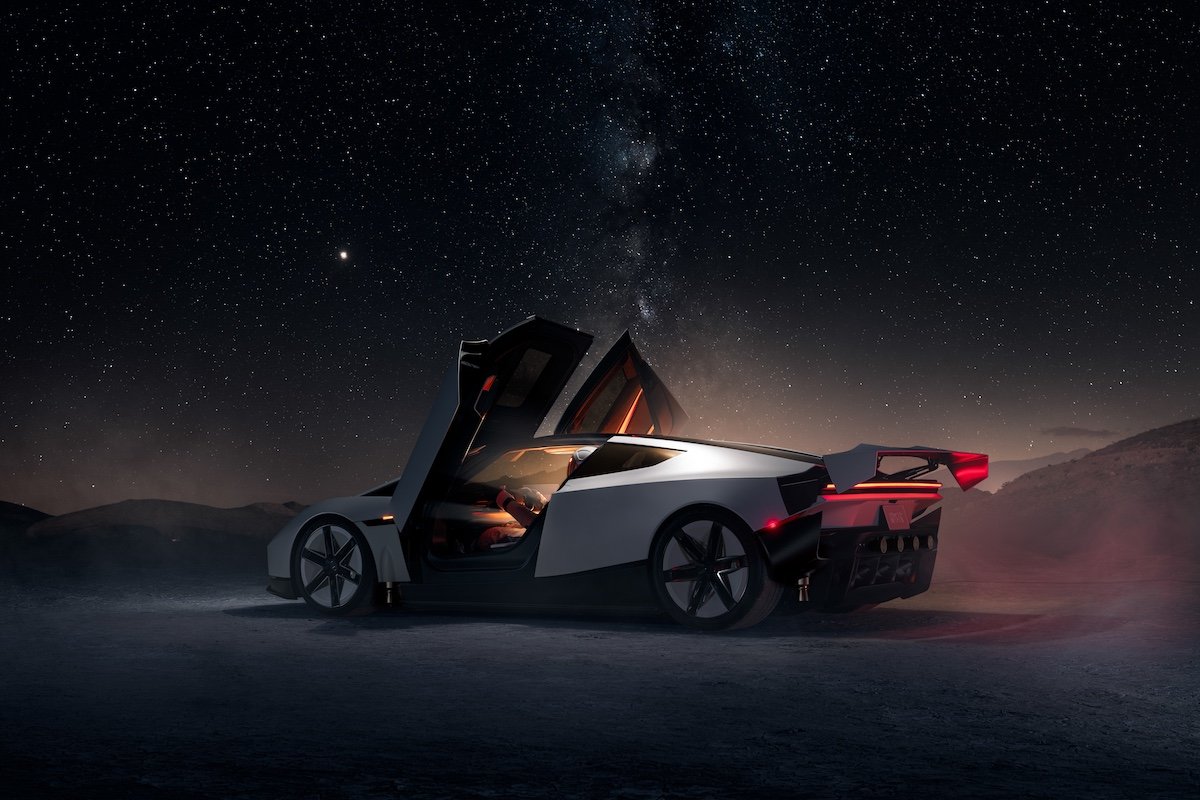
A show under the Texas sky
For its big comeback, the Roadster didn’t pick an auto show but McGregor, Texas, where SpaceX fires up its rocket engines. The stage was set, and so was the wait: Elon Musk had promised an “unforgettable” demo by the end of 2025, before the April 1 and then October 1, 2026 dates slipped in turn, the second one because of the weather. Ironically, for a car meant to defy gravity, it was the sky that had the last word.
On stage were Elon Musk and Lars Moravy, Tesla’s vice president of vehicle engineering. Musk first explained why there was a live audience with a very 2026 argument: they needed witnesses to prove that what came next wasn’t AI-generated. Then he cautiously warned: “Success is not guaranteed.”
Upside down, then over the cars
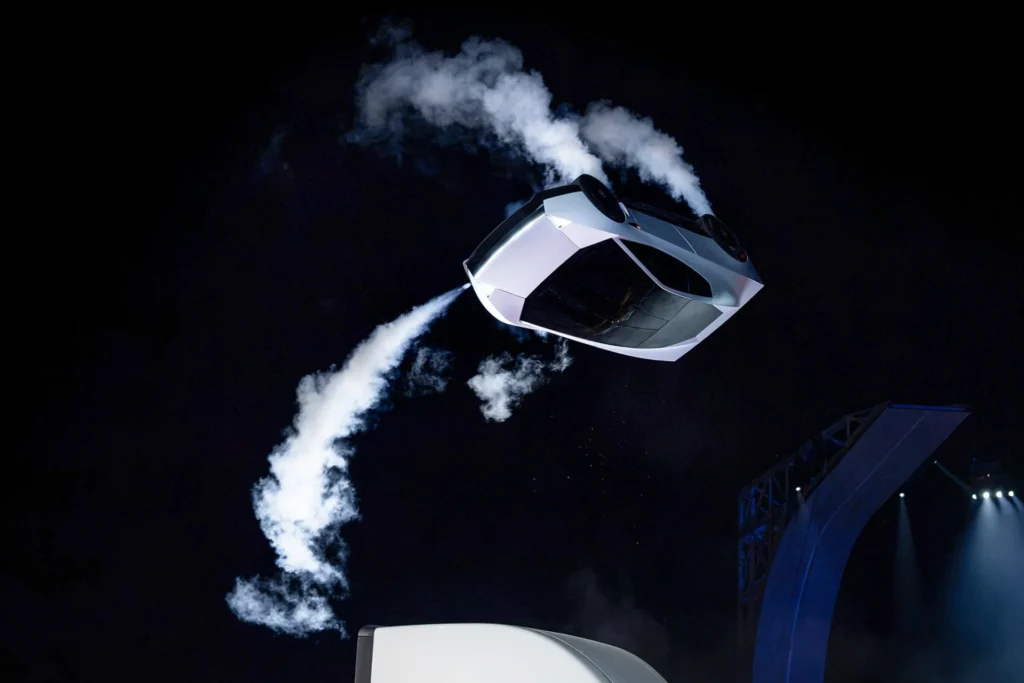
First demo: the Roadster charges up a huge curved ramp, skate half-pipe style, until it is driving completely upside down. Fans under the body press it against the wall by creating suction that can “pull up to 2 G,” according to Lars Moravy. At the top, the car breaks away, rotates in midair using its thrusters and lands cleanly on all four wheels. Elon Musk’s understated verdict: “Well, that worked.”
Second act: launched down the track, the Roadster takes off and leaps over a row of parked Teslas, Cybertruck and Semi truck included, before touching down on the other side. Sharp-eyed viewers will have noticed one detail: nobody was on board. The demos followed a preprogrammed sequence. So Tesla’s first flying car was piloted by a computer, which is fairly consistent for a brand betting everything on self-driving.
“It turns out the future does have flying cars.” — Elon Musk, in McGregor
How does it fly? On compressed air
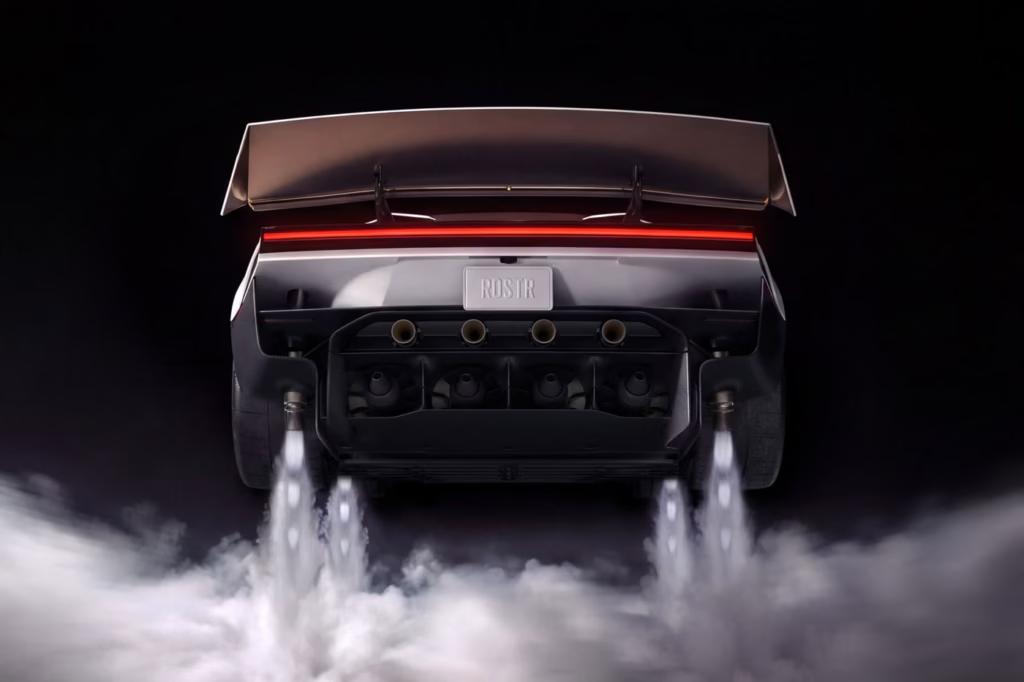
Forget the flames and the roar of a Raptor. The Roadster uses cold gas thrusters, developed with SpaceX: compressed gas is stored in composite tanks, the same kind used in the space industry, then released through nozzles spread across the body. No combustion, no fuel: an onboard compressor refills the tanks. It is, in short, the principle of a balloon you let go of, with a bit more discipline in the trajectory.
These thrusters aren’t just for jumping. Fired rearward, they push the car in a straight line with, according to Tesla, four to five times the force the tires can put down on the road. That’s what lets it escape the usual limits of grip and post that famous 0 to 60 mph in 0.81 seconds, measured during a recorded run and billed as the quickest ever achieved by a production car. The figure has not yet been verified by an independent body.
There is one big caveat, though: this isn’t flight in the sense of an airplane or a drone, but hops lasting a few seconds. Tesla hasn’t said how long the car can stay in the air or how many maneuvers a single gas charge allows. So the Roadster won’t be flying over rush-hour traffic on the A86 outside Paris. Not yet, the optimists will say.
Three versions, from asphalt to sky
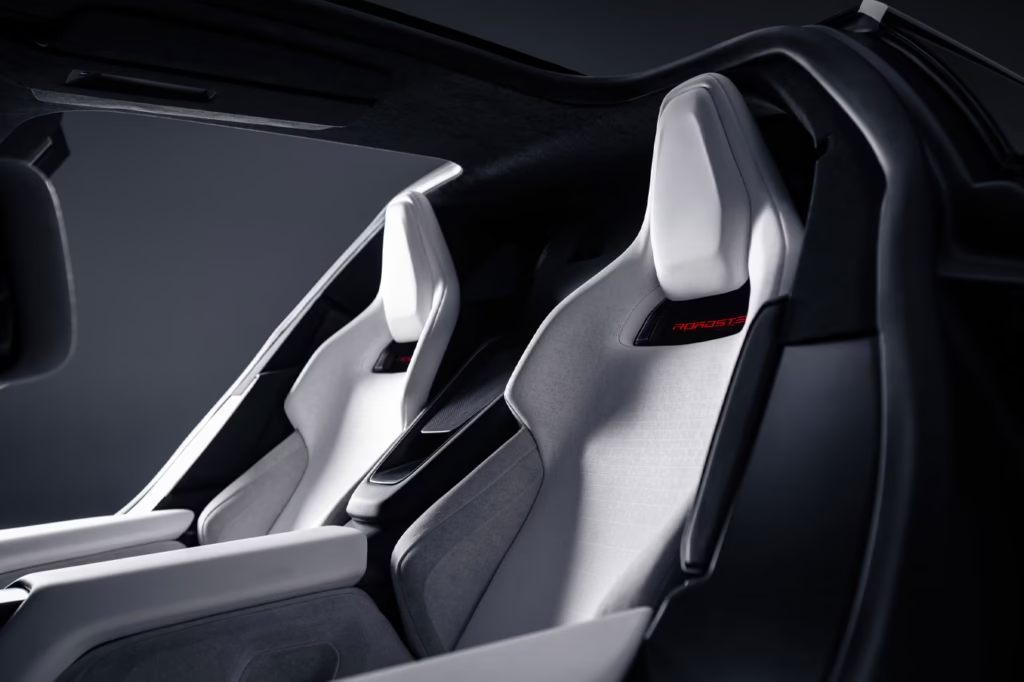
Tesla offers its Roadster in three levels, with slogans that sum up the progression nicely. The two-seat Performance version makes do with active aerodynamics and the suction system: it is billed as “road ready.” The Thrust adds rear thrusters for acceleration and calls itself “track ready.” Finally, the single-seat Rocket carries the full flight system and declares itself “air ready.” It is available by invitation only and is not street legal.
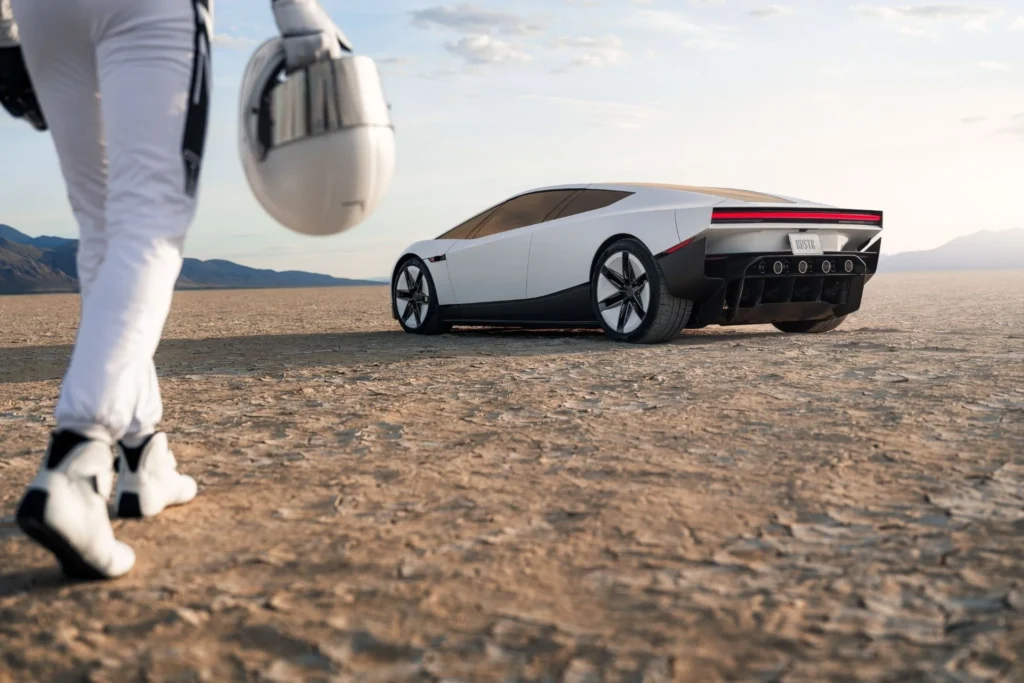
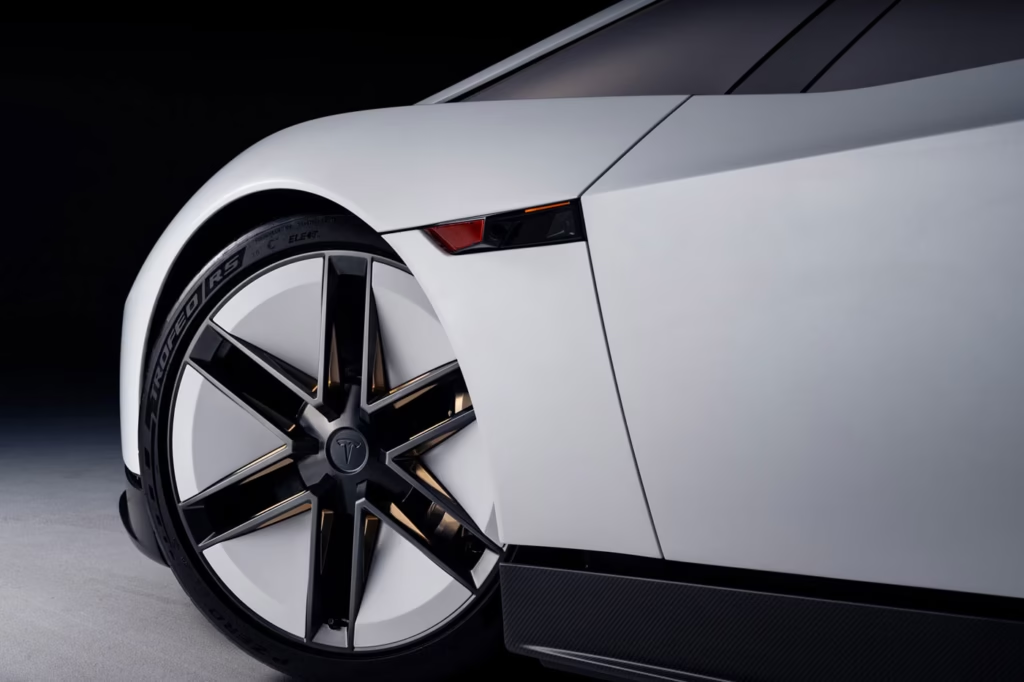
On the design side, penned by Franz von Holzhausen, Tesla claims an “aerospace aesthetic” inspired by the SR-71 spy plane and the F-35 fighter jet: a sharp-edged coupe, butterfly doors, a deployable spoiler, seats molded directly into the chassis and steer-by-wire, with no mechanical link between the steering wheel and the wheels.
And the price? Still a mystery. No final pricing has been announced. Reservations, open on Tesla’s US website, require a $50,000 deposit for the Performance and $250,000 for the Thrust. Back in 2017, Tesla announced a starting price of $200,000. Production is now slated for 2028, with no timeline for Europe.
A promise scaled back (except in altitude)
A quick look back. In November 2017, Tesla unveiled a first prototype of the new Roadster and promised deliveries in 2020. Then the company prioritized its mass-market models, the Cybertruck, self-driving and the Optimus robot. In the meantime, some famous customers ended up asking for their deposits back.
Comparing the spec sheets is revealing. In 2017, Tesla announced 0 to 60 mph in 1.9 seconds, a top speed of over 250 mph and nearly 620 miles of range. Today, the acceleration time has been cut by more than half, but top speed is quoted at over 230 mph and range at around 300 miles. The Roadster gained wings, and lost miles. Elon Musk is nonetheless aiming, eventually, for “half the speed of sound.”
Then there’s the question of safety, which Elon Musk himself brushed aside with a certain nonchalance: the Roadster is “not necessarily a safety-optimized car.” Asked whether its flight features would be legal on open roads, he replied: “It depends on your street.” In Europe, it’s hard to picture a vehicle inspection signing off on pressurized gas nozzles.
The last car for humans
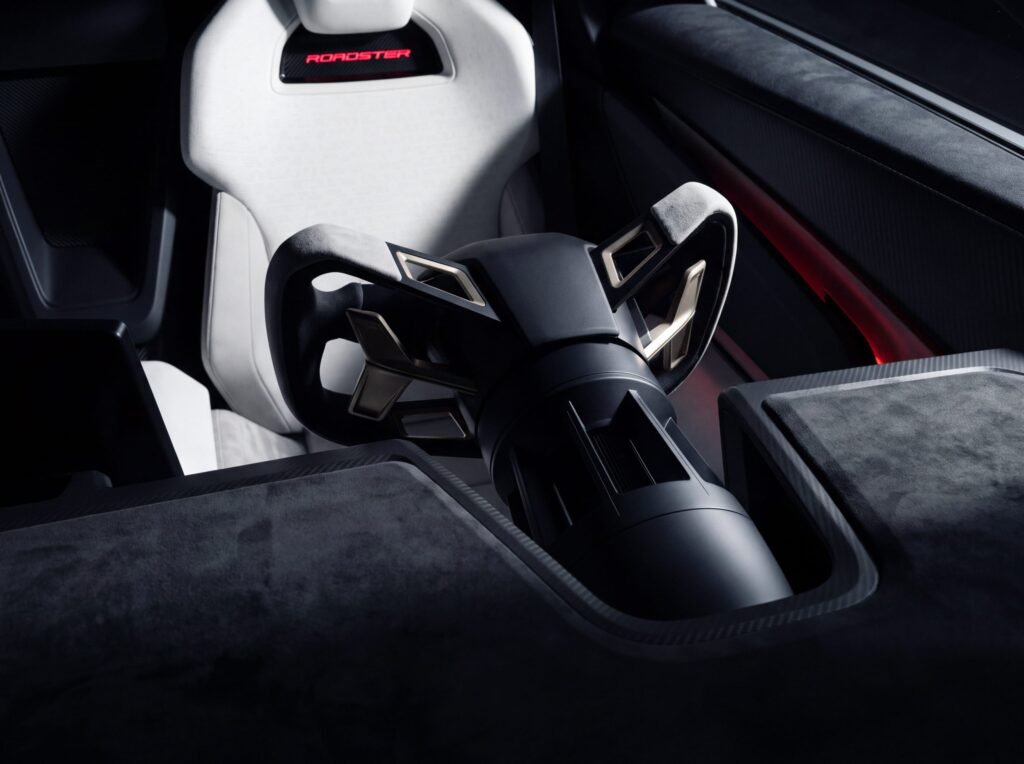
The most surprising thing may not be the flying, but the paradox. Tesla presents the Roadster as its only manually driven car, “the best of the last cars driven by humans.” A technology showcase more than a volume product, as Elon Musk himself admits, since he isn’t counting on it to turn around falling sales. Its real payoff may lie elsewhere anyway: active aerodynamics and suction for extra grip will interest far more than just stunt fans.
One last wink to finish. Tesla’s first Roadster, Musk’s own, has been orbiting the Sun since February 2018, sent into space by a Falcon Heavy with a mannequin named Starman at the wheel. Its successor settles for a few feet of altitude and a few seconds of flight. It doesn’t go as far, but it has the advantage of coming back. Doc Brown called it: where we’re going, we don’t need roads. He just forgot to mention we’d have to wait until 2028.
THE ROADSTER BY THE NUMBERS (AS ANNOUNCED BY TESLA)
- 0 to 60 mph: 0.81 s (recorded run, not independently verified)
- Top speed: over 230 mph
- Range: about 300 miles
- Performance: 2 seats, active aerodynamics and fan suction, “road ready.” Deposit: $50,000
- Thrust: 2 seats, rear cold gas thrusters, “track ready.” Deposit: $250,000
- Rocket: 1 seat, full flight system, not street legal. By invitation only
- Final price: not disclosed
- Production: slated for 2028
Flight time, weight and battery capacity have not been disclosed.




Comments 0
No comments yet: start the conversation!
Your Discord name and picture will sign your comment. Be courteous: inappropriate comments are removed.