


On Friday 30 October, France’s National Assembly voted for a tax of 5.5 cents on every gigabyte sent to French internet users. On paper, the platforms pay. In practice, tax history shows where this kind of bill tends to land: in household budgets.
What is this tax, who will really pay it, and what will it change for our subscriptions and online purchases? Here is our breakdown.
The essentials in 30 seconds
- The rate: €0.055 per gigabyte, or €55 per terabyte.
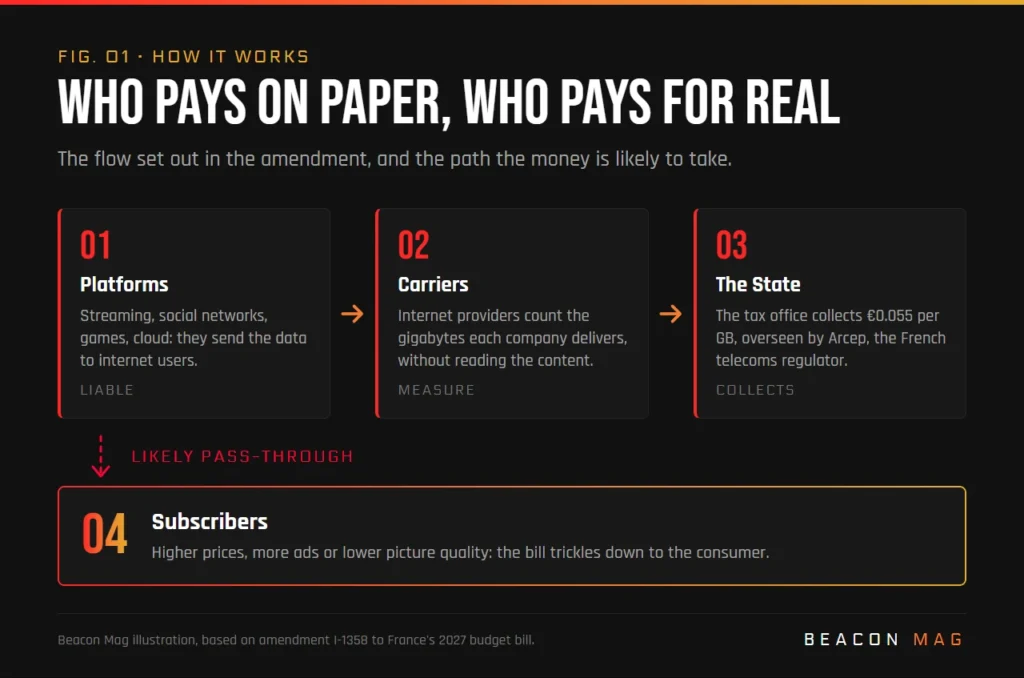
- Who pays: the companies that send the data (video platforms, social networks, game publishers, cloud services, TV channels…). Not the subscriber, and not the internet provider.
- How it is measured: carriers count the volumes each company sends, without looking at the content, and pass the figures to the tax office under the supervision of Arcep, the French telecoms regulator. The details would be set by decree.
- The cap: 15% of revenue made in France or 2% of worldwide revenue.
- Expected revenue: up to €10 billion a year according to its authors, based on around 200 billion GB a year. The government puts it closer to €5 billion.
What was voted
On Friday 30 October 2026, at 9 a.m., in the middle of the debate on the 2027 budget bill (projet de loi de finances, or PLF), MPs adopted amendment no. I-1358. It creates a levy of €0.055 per gigabyte of data delivered to the customers of internet service providers in France.
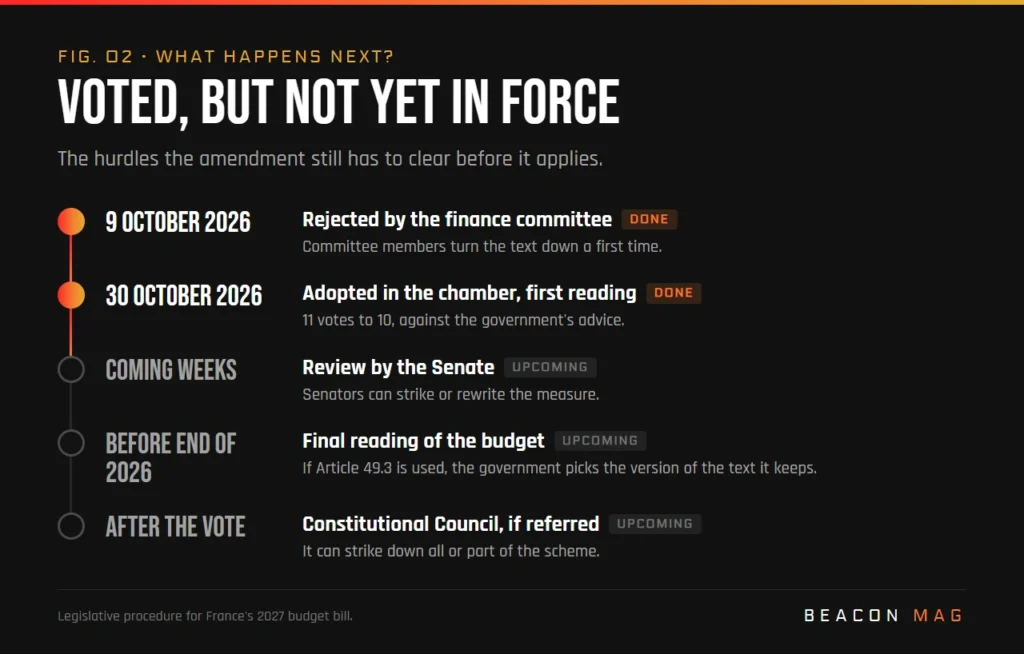
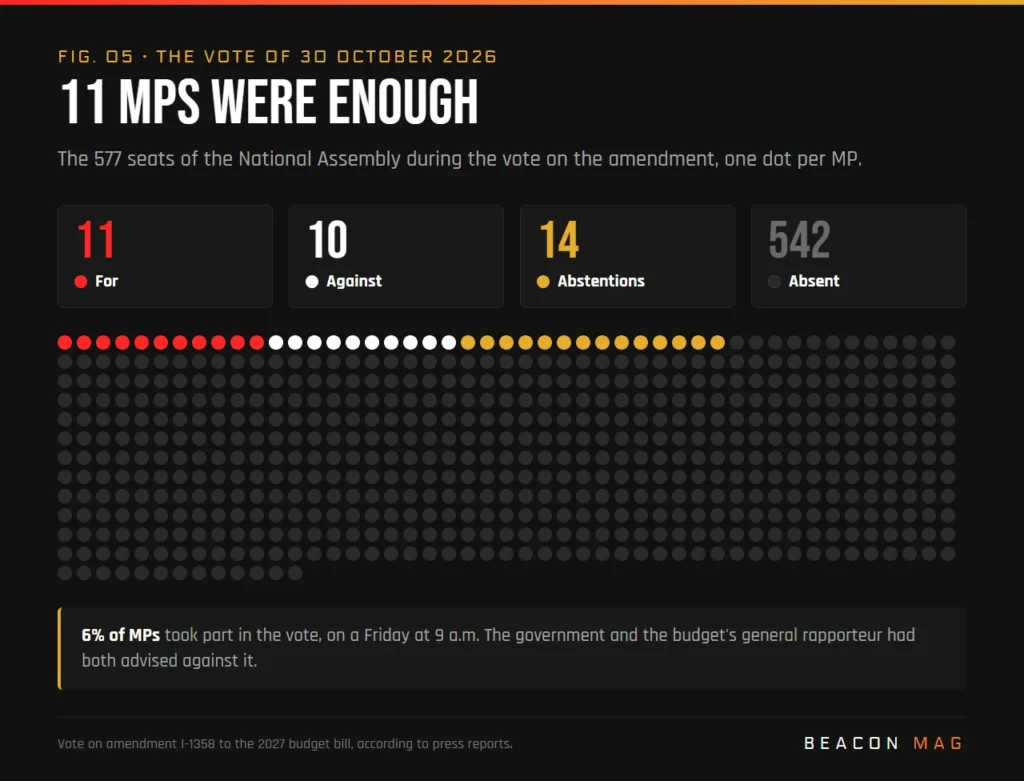
The result: 11 votes for, 10 against, 14 abstentions. Thirty-five MPs present out of 577. The government and the budget’s general rapporteur had both advised against it, and the finance committee had rejected the text on 9 October. The version presented last summer even proposed €0.10 per GB.
Nothing is final yet
This vote is a step, not a law. The budget bill still has to go through the Senate, and the government can call for a second deliberation or force the budget through with Article 49.3 of the Constitution, which lets it adopt a text without a final vote, in a version without this amendment. If the measure survives, the Constitutional Council could also be asked to rule on it, and lawyers are already questioning whether it complies with European law. But the signal it sends is very real.
A meter on your everyday use
To grasp the scale of it, just bring those 5.5 cents back to everyday uses.
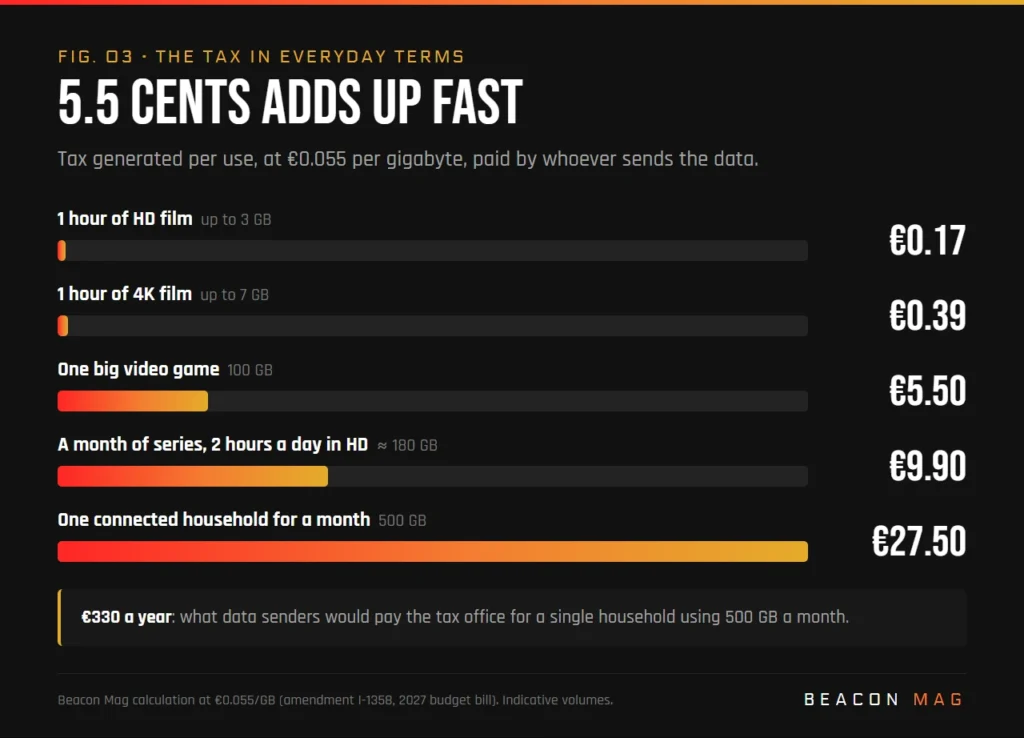
These amounts will not appear on your internet bill. They will be paid by the company sending you the data. But for a streaming service whose subscription costs between €6 and €20 a month, a tax that can approach €10 per heavy user is enormous. Only the cap of 15% of French revenue limits the damage, and that cap says it all: the tax is designed to take up to 15% of what you pay.
What will happen to your subscriptions
A company facing higher costs has four levers: raise its prices, cut quality, trim its margins or leave the market. The first three affect you directly.
Video and music streaming
This is the most exposed sector, because video makes up most internet traffic. “France-only” price rises are the most likely scenario. The other, more discreet option is to lower quality: reduced bitrate, less 4K, more aggressive compression. You would then pay the same price for a less sharp picture.
Free services
Online video, social networks: here, there is no price to raise. The bill will be paid in extra advertising, features reserved for paying subscribers, or cut-price quality.
French companies, the first victims
This is the cruellest paradox. According to the government, nearly half of the revenue could come from smaller players, not just American giants. TV channels’ streaming platforms, French streaming services, national cloud hosts, video game studios…
The non-profit association behind a famous open-source media player estimated that the tax could cost it over a million euros a year. The amendment’s author replied that the cap would spare it. The fact that the question even comes up says a lot about how vague the text is. And when public TV channels stream online, the State would end up taxing itself, with taxpayers’ money.
Video games
Modern games routinely weigh 100 to 200 GB, not counting updates. For a publisher, that means €5.50 to €11 of tax per download, and again with every reinstall. For a game sold at €70, that is around 8 to 16% of the price. For a free-to-play game, it is a pure loss, which will end up being made up through microtransactions. Cloud gaming, which by nature uses a lot of data, could simply become unprofitable in France.
Cloud services and businesses
Online backups, collaboration tools, video calls, software updates: all of this travels over the networks. The extra cost would find its way into the business subscriptions of small companies, then into the price of their own products.
“The giants will pay”: a well-known illusion
Economists have a name for this: tax incidence. Whoever hands the tax to the State is not necessarily the one who bears it. When a company dominates its market and its customers cannot easily do without it, it passes the tax down the chain, to the consumer.
And we already have proof that this is how it works. In 2019, France created a 3% tax on the digital revenue of the big platforms, the so-called “GAFA tax”. As early as October 2019, Amazon raised the fees charged to French sellers on its marketplace by 3%. In November 2020, Google in turn added a 2% fee on ads shown in France. The giants billed the tax back to French small businesses, which then built it into their prices. The loop was closed.
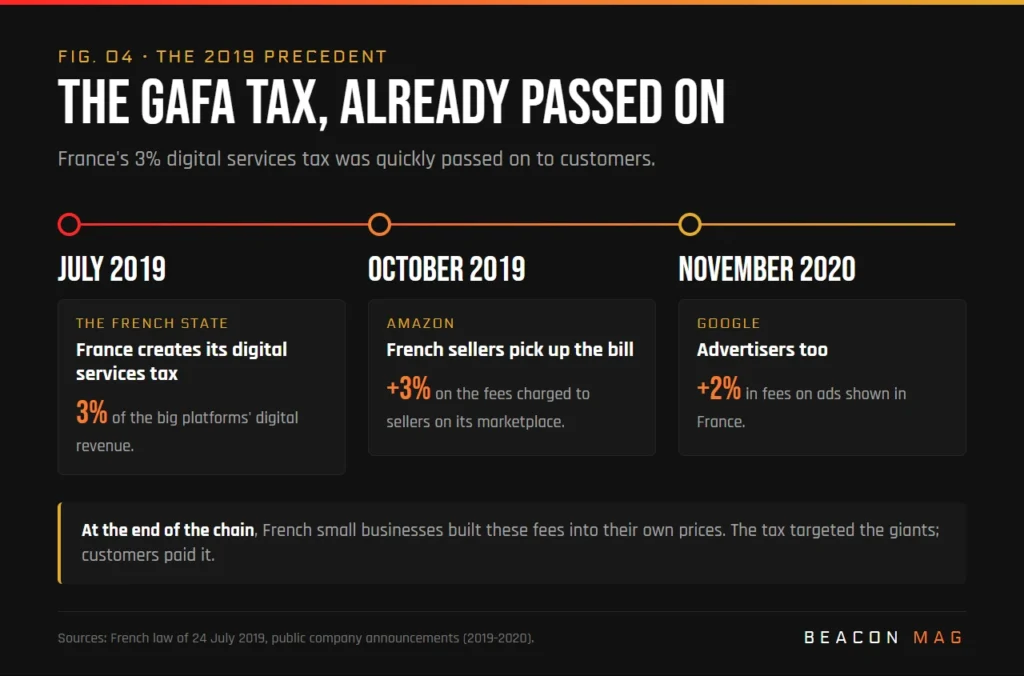
There is no reason to think the gigabyte tax will escape this mechanism. It is even easier to pass on: it is proportional to consumption, so it is easy to turn into a per-subscriber surcharge.
The hypocrisy of a message
This is where it hurts. In recent years, many elected officials have built their message on two promises: defending the French people’s purchasing power and tackling the excesses of globalised capitalism. These are legitimate fights. But a gigabyte tax does exactly the opposite of what it claims.
It does not hit capital, it hits consumption. A tax on data volume has nothing to do with a company’s profits. A hugely profitable giant and a loss-making French start-up pay the same rate per gigabyte. A platform that optimises its taxes through Ireland will keep doing so; it will simply add a line to its French prices.
It weighs most on those who have least. A streaming subscription or a family internet connection takes a much bigger share of a modest household’s budget than of a well-off one. Like any tax on consumption, this one is mechanically regressive.
It strengthens the biggest players. Only multinationals will have the means to absorb this cost, negotiate, adapt or compress their data flows. Smaller players, often European, will take the full hit. A measure meant to “make the giants pay” could end up helping them crush their competitors.
And meanwhile, the State cashes in. Ten billion euros a year is the stated goal. But it is not Silicon Valley shareholders’ money that will fill the coffers: it is French subscribers’ money, a few euros a month, collected through their subscriptions. Presenting this as a social justice measure is economic naivety at best, sleight of hand at worst.
The unease is also democratic. A measure that could affect every connected household in the country was adopted by 11 MPs out of 577, on a Friday morning, against the advice of the government and the finance committee. Whether you are for or against it, a decision of this scale deserves a real public debate.
The real problem exists, but this is the wrong tool
To be fair, the starting point is not absurd. The big platforms generate most of the traffic, benefit from infrastructure paid for by others and pay taxes in France out of all proportion to their real activity. This debate is also under way at European level, under the name of a “fair share” contribution from large traffic generators.
But there are better-targeted tools: taxing the profits actually made in France, international coordination on a global minimum tax for multinationals, or negotiated agreements between carriers and platforms to fund the networks. They all have one thing in common: they target profits, not the gigabytes you use in the evening watching your favourite series.
What now?
The ball is now in the court of the Senate and the government. The amendment can still be removed, rewritten or set aside through Article 49.3. But the mere fact that it was voted should alert everyone who uses the internet every day, which is to say almost everyone.
Because at the end of the cable, there is no Netflix, Google or Meta. There is you.




Comments 0
No comments yet: start the conversation!
Your Discord name and picture will sign your comment. Be courteous: inappropriate comments are removed.