

Sol system: the cradle of humanity and the capital of the Empire
Worlds & systems 0 replies Followed by 0 members

JakeCook Administrator
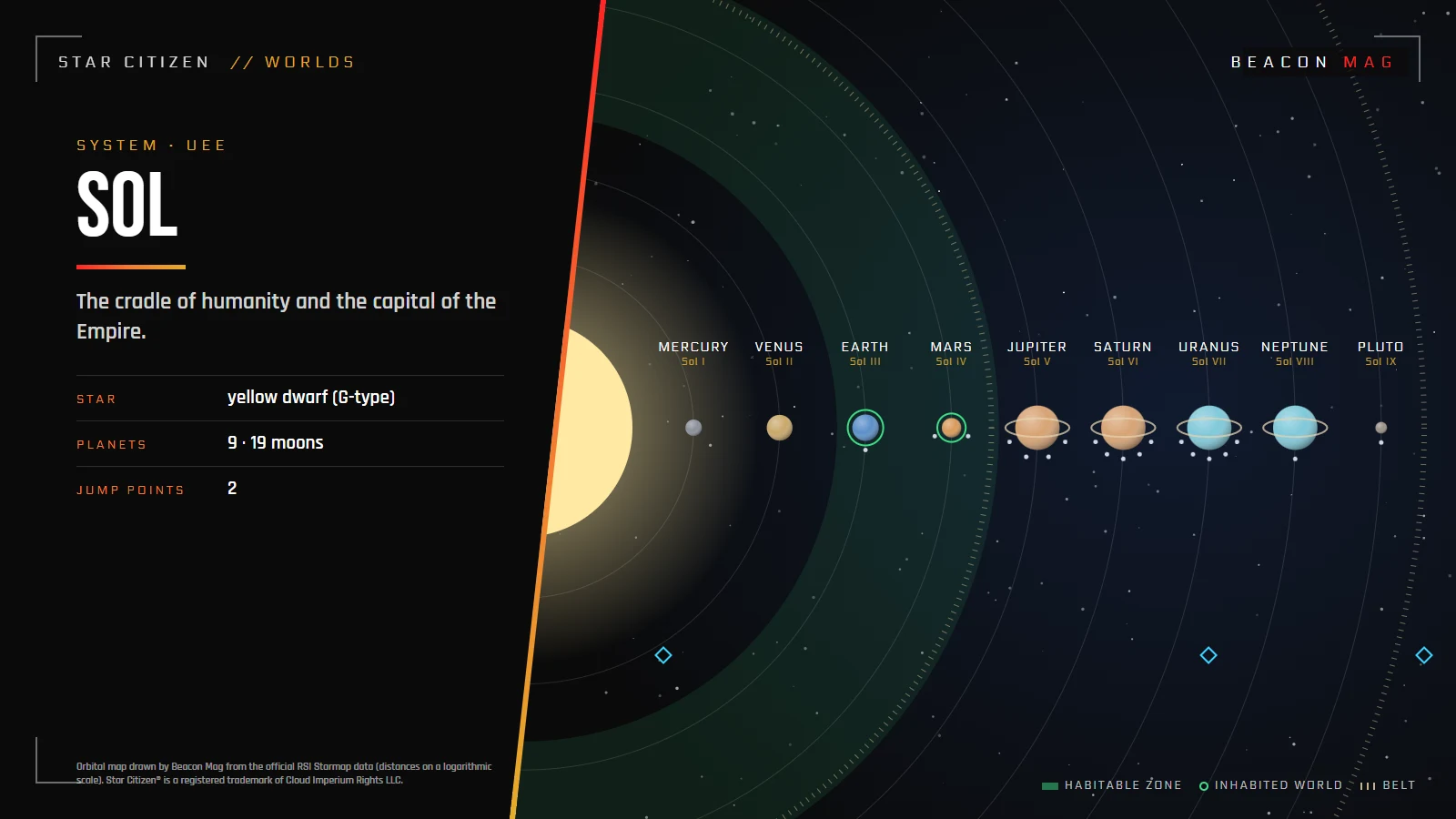
The cradle of humanity and the capital of the Empire. The Imperator, the Senate and most major UEE institutions sit on Earth (Sol III). Sol also has Mars, the first planet ever terraformed by humans, and key stations such as the TDD Kesner sorting hub and the INS Dunleavy naval base.
🪪 The system at a glance
| Affiliation | UEE (United Empire of Earth) |
| Star | Sol: yellow dwarf (G-type) |
| Planets | 9 |
| Moons | 19 |
| Belts and clusters | 2 |
| Stations | 3 |
| Habitable zone | 0.9 to 3 AU from the star |
| Jump points | 2 |
🪐 Its worlds, from the star outwards
Sol I · Mercury (iron planet)
Mercury: its eccentric orbit gives it the widest temperature swings in the system.
Sol II · Venus (smog planet)
Venus: its atmosphere, almost entirely CO₂, makes it the hottest planet in Sol.
Sol III · Earth (rocky planet)
Earth, humanity’s homeworld and the UEE’s capital, centre of politics, trade and culture. Centuries of habitation have stripped its resources: its billions depend on imports.
👥 inhabited
Its moon:
- Luna (Sol 3a): The Moon, tidally locked with Earth: the first celestial body humanity ever visited.
Sol IV · Mars (desert planet)
Mars, prosperous and populous, the first successfully terraformed planet. The process was marred by the “Mars Tragedy”, a disaster that killed 4,876 people in 2125.
👥 inhabited
Its moons:
- Phobos (Sol 4a): Phobos, so close to Mars that it rises in the west and sets in the east twice every Martian day.
- Deimos (Sol 4b): Deimos, 6.2 km in radius: more asteroid than moon.
Sol V · Jupiter (gas giant)
Jupiter, the largest planet in the system.
Its moons:
- Io (Sol 5a): Io, the most volcanically active object in the system, heated by Jupiter’s tides.
- Europa (Sol 5b): Europa, whose icy surface is one of the most reflective in the system.
- Ganymede (Sol 5c): Ganymede, the system’s largest moon and the only one with a magnetosphere.
- Callisto (Sol 5d): Callisto, the oldest and most heavily cratered surface in the system.
Sol VI · Saturn (gas giant)
Saturn, famous for its rings.
Its moons:
- Titan (Sol 6a): Titan, with its ethane and methane lakes: the only moon in Sol with a dense atmosphere.
- Rhea (Sol 6b): Rhea, made of rock and ice: a “dirty snowball”.
- Tethys (Sol 6c): Tethys, mostly water ice, hence its low density.
- Dione (Sol 6d): Dione, whose craters on its trailing side suggest bombardment once spun it 180°.
- Iapetus (Sol 6e): Iapetus, two-faced: one side dark, the other bright.
Sol VII · Uranus (ice giant)
Uranus: its axis is so tilted that its poles sit where other planets have their equator.
Its moons:
- Miranda (Sol 7a): Miranda, home to Verona Rupes, the tallest cliff in the system.
- Ariel (Sol 7b): Ariel, crisscrossed by scarps, canyons and ridges.
- Umbriel (Sol 7c): Umbriel, “the shadow”, the darkest of Uranus’s moons.
- Titania (Sol 7d): Titania, Uranus’s largest moon, cut by enormous canyons.
- Oberon (Sol 7e): Oberon, named after Shakespeare’s faery king, its surface reddened by space weathering.
Sol VIII · Neptune (ice giant)
Neptune, whose differential rotation drives the strongest winds in the system.
Its moon:
- Triton (Sol 8a): Triton, Neptune’s largest moon.
Sol IX · Pluto (dwarf planet)
Pluto, a dwarf planet of ice and rock, the first Kuiper Belt object ever discovered.
Its moon:
- Charon (Sol 9a): Charon, so influential on Pluto that the pair has been classified as a binary dwarf planet several times.
☄️ Belts, clusters and stations
- Herschel Belt (asteroid belt): The Herschel Belt (the main belt): over half its mass lies in four large asteroids.
- Kuiper Belt (asteroid belt): The Kuiper Belt, made of small bodies left over from the system’s formation.
- TDD Kesner (space station): A major shipping hub: most cargo bound for Earth is processed here to ease congestion at the capital.
- IMS Bolliver (space station): A former Marine base, out of service since they moved to Mars, but still strictly off limits.
- INS Dunleavy (space station): An orbital naval base, operational centre of the Sol fleet.
🧭 Jump points to
📚 Every system and its worlds (contents)
Official data: Roberts Space Industries Starmap (checked 19 October 2026), text rewritten by Beacon Mag. Orbital map: Beacon Mag, based on that data (planets in their real order around the star, spaced out for readability). Star Citizen® is a registered trademark of Cloud Imperium Rights LLC.
Join the discussion
Sign in with DiscordYour Discord name and picture will sign your messages. Be courteous: inappropriate messages are removed.