


What is a geostationary orbit ?
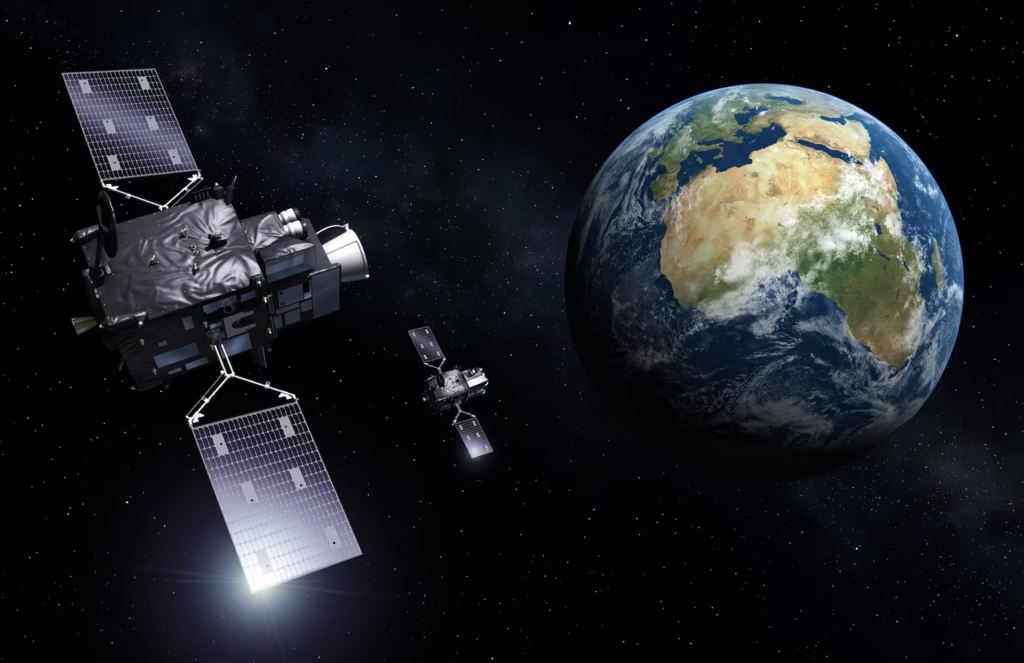
It is a circular orbit in the plane of the equator, 35,786 km up, a little under a tenth of the distance from the Earth to the Moon. A satellite placed there completes one lap at exactly the pace the Earth spins: 23 h 56 min 4 s. Not a neat 24 hours, since the planet never checked our clocks.
Why that altitude and no other? Because in orbit you do not get to pick your speed: the lower a satellite flies, the faster it must go to avoid falling back. The International Space Station, at 400 km, circles the globe in an hour and a half. The Moon takes its time: about 27 days. Between the two, there is only one altitude where a lap lasts exactly one day. No engineer decided that; celestial mechanics sets the address.
One detail to drop at dinner parties: any orbit synchronised with the Earth’s rotation is called geosynchronous. But if it is tilted, the satellite traces a figure of eight in the sky over the course of the day. To earn the title geostationary, it has to tick three boxes: the right period, a circular path and a position directly above the equator.
Why is it so useful?
Seen from the ground, the satellite appears motionless. An antenna can stay pointed at it permanently, with no need to track it. The dish bolted to the roof has not moved a millimetre since it was installed, stormy nights aside. That is ideal for television and telecommunications, and for weather too: Meteosat over Europe, GOES over the Americas and Himawari over Asia-Pacific keep a constant watch on the same part of the globe.
The other asset is the view. From that height, a single satellite takes in about 42% of the Earth’s surface. Three well-spaced spacecraft are enough to cover almost the whole planet.
Almost, because the balcony has its flaws:
- The poles are poorly served. Beyond roughly 81° of latitude, the satellite drops below the horizon.
- Distance has a price. A signal takes close to a quarter of a second to go up and come back down. That is the awkward little pause between the TV studio and the correspondent in the field.
- Seats are limited. There is a single ring for everyone, and positions are coordinated by the International Telecommunication Union.
The spot is so sought after that nobody overstays. At the end of its life, a geostationary satellite uses its last drops of fuel to climb about 300 km into a “graveyard orbit”. The slot is free for the next one.
Why is it sometimes called the “Clarke Belt” ?
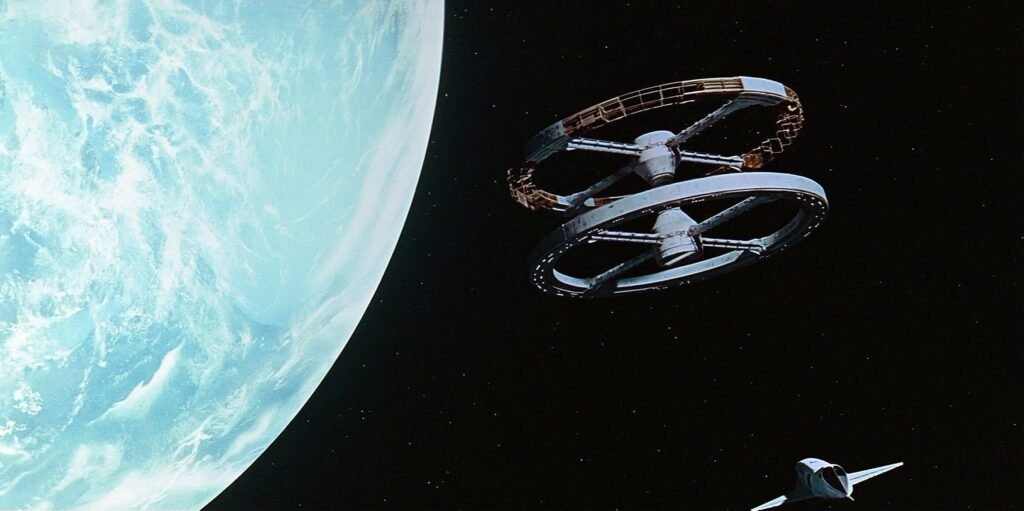
In tribute to British writer Arthur C. Clarke, future author of 2001: A Space Odyssey. In October 1945, he published an article in the magazine Wireless World titled “Extra-Terrestrial Relays”. In it he described three stations placed in this orbit, able to relay communications from one side of the planet to the other.
Clarke did not discover the orbit itself. The Russian Konstantin Tsiolkovsky had mentioned it, and Slovenian engineer Herman Potočnik had already put a space station there in a 1928 book. But Clarke was the one who saw what it was for and popularised it: a worldwide telecommunications network, twelve years before Sputnik.
His one forecasting error: he pictured crewed stations, with technicians on board to replace the vacuum tubes. The transistor, invented two years later, spared them the trip.
Events proved him right very quickly. In 1964, Syncom 3 became the first geostationary satellite and relayed the Tokyo Olympic Games to the United States. Clarke himself had never patented his idea. He later turned that into an essay on how he lost a billion dollars in his spare time. In lieu of royalties, he has an orbit named after him, which is more than most of us can say.
Geostationary orbit in numbers
| Marker | Value |
|---|---|
| Altitude | 35,786 km above the equator |
| Orbital radius | 42,164 km from the centre of the Earth |
| Satellite speed | about 3.07 km/s, or 11,000 km/h |
| Time for one lap | 23 h 56 min 4 s |
| Visible surface | about 42% of the globe per satellite |
| Signal delay | about 0.25 s up and back down |
| First geostationary satellite | Syncom 3, in 1964 |




Comments 0
No comments yet: start the conversation!
Your Discord name and picture will sign your comment. Be courteous: inappropriate comments are removed.