

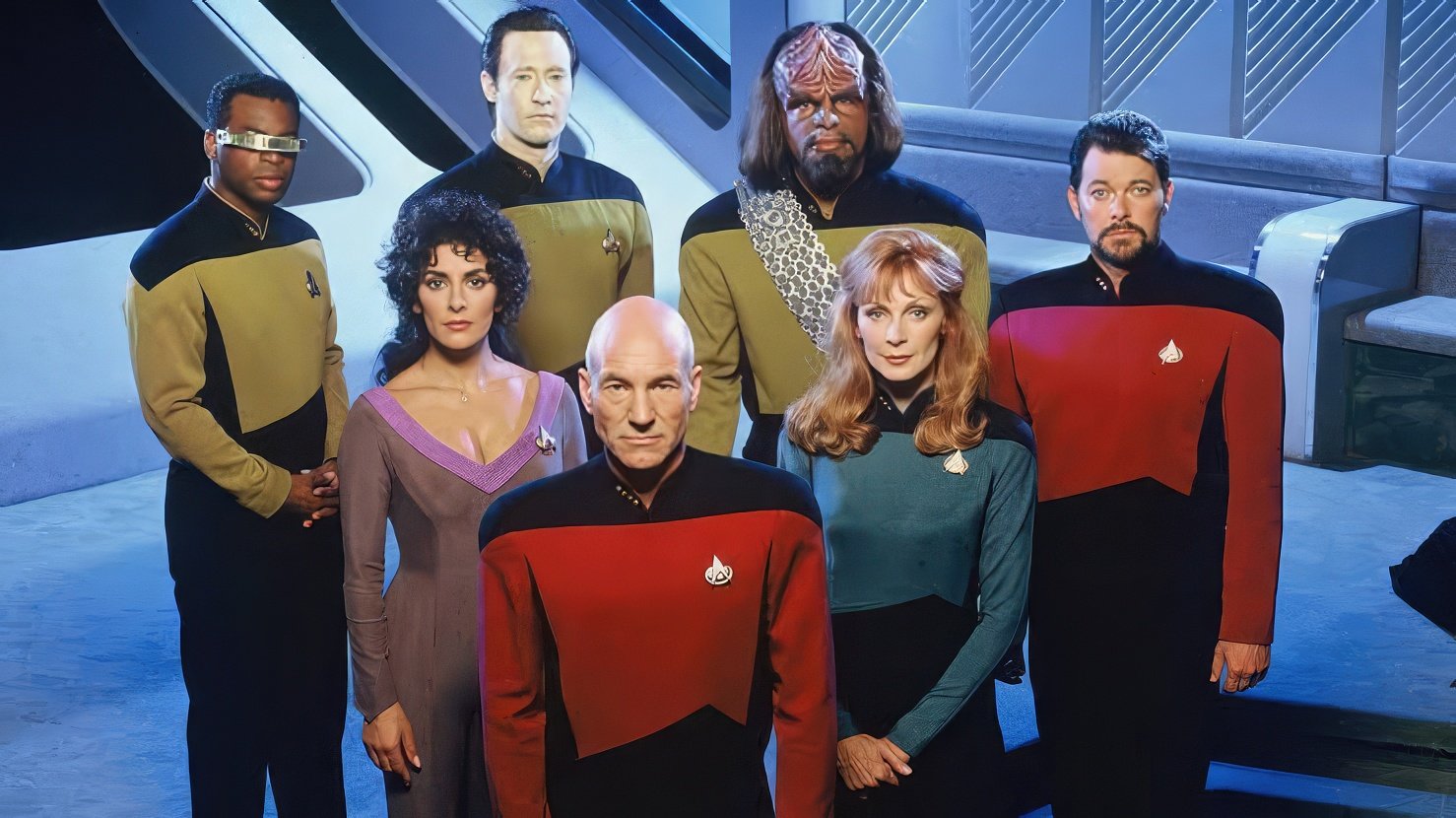
He had the voice of a Shakespearean king, the gaze of a commander and the humour of a Yorkshire lad who could never quite believe his luck. Sir Patrick Stewart died on 28 October 2026, aged 86. For millions of viewers, he will forever be Captain Jean-Luc Picard and Professor Charles Xavier. But the man was far more than his two most famous uniforms.
The actor died at his home in Los Angeles, surrounded by his loved ones and his wife, the singer Sunny Ozell. His longtime spokesperson, Kelly Bush Novak, announced the news the following day: he had been living with Alzheimer’s disease and Lewy body dementia, an illness as brief as it was cruel. His final days were spent with music, in the warmth of his family and friends.
With him goes one of the most beloved figures in science fiction. He was also one of the rare actors to bridge the gap between the Royal Shakespeare Company and the bridge of the Enterprise, without ever sacrificing one for the other.
The essentials in 30 seconds
- A farewell: Patrick Stewart died on 28 October 2026 in Los Angeles, aged 86, following Alzheimer’s disease and Lewy body dementia.
- Humble roots: born in 1940 in Mirfield, Yorkshire, he left school at 15 before training as an actor.
- A Shakespearean pillar: more than 60 productions with the Royal Shakespeare Company and several Laurence Olivier Awards.
- Two legendary roles: Jean-Luc Picard in Star Trek (1987-2023) and Charles Xavier in the X-Men saga (2000-2026).
- One last appearance: we will see him one final time as Xavier in Avengers: Doomsday, due in cinemas in December.
Mirfield: a soldier’s son

Patrick Stewart was born on 13 July 1940 in Mirfield, a small working-class town in West Yorkshire, in the middle of the Second World War. The family was of modest means. His father, Alfred, was a career soldier; his mother, Gladys, worked in the textile trade. The household was scarred by the violence of a father who had come back from the front deeply damaged. Only much later would the actor understand that this man was suffering from what we now call post-traumatic stress disorder.
That childhood wound would become one of the driving forces of his adult life. Throughout his life, Patrick Stewart campaigned for survivors of domestic violence, in memory of his mother, and for veterans living with mental health conditions, in memory of his father.
At 15, he left school and became a trainee reporter on a local newspaper. But the stage was already calling: he acted with amateur companies, to the point of neglecting his stories for rehearsals. He eventually won a place at the Bristol Old Vic Theatre School. At around 19, he lost his hair. A disaster for a young actor, or so he thought at the time. Yet that bald head would become one of the most recognisable silhouettes in popular culture.
Shakespeare before the stars
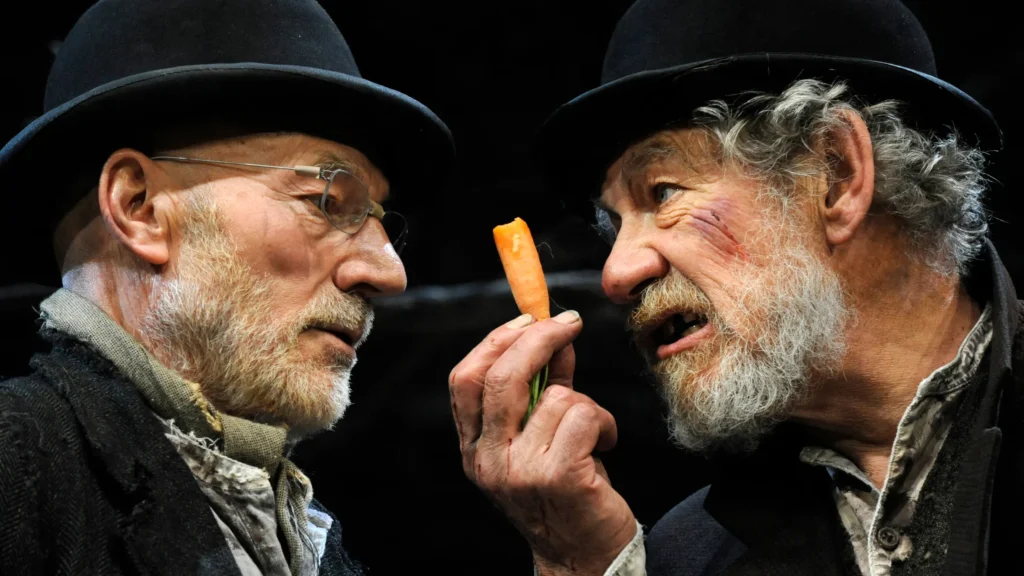
In 1966, Patrick Stewart joined the Royal Shakespeare Company. He remained one of its pillars until 1982, appearing in more than 60 productions in all, which later earned him the title of Honorary Associate Artist. It was there that he learned to carry verse, to fill a theatre with the sheer power of his voice, and to give nobility to tyrants and fools alike. In 1979, his Enobarbus in Antony and Cleopatra won him his first Laurence Olivier Award.
It was also at the RSC that he met Ian McKellen, the future Magneto and a lifelong friend. A friendship that began with a memorable piece of advice: when Stewart told him about an offer from Hollywood for a science fiction series, McKellen advised him to turn it down. Luckily for us, he did not listen.
Meanwhile, Stewart made his mark on screen in memorable supporting roles: the ambitious Sejanus in I, Claudius, the enigmatic Karla in the BBC’s Tinker Tailor Soldier Spy, King Leondegrance in John Boorman’s Excalibur (1981), and Gurney Halleck in David Lynch’s Dune (1984). Science fiction was already crossing his path.
Jean-Luc Picard, captain for eternity
In 1987, Paramount was preparing the big return of Star Trek to television. To succeed Captain Kirk, Gene Roddenberry imagined a French commander… and had no wish to hire a bald British actor. It took all the insistence of the other producers to change his mind. Stewart himself thought the adventure would last a few months. It lasted seven seasons and 178 episodes.
His Picard was unlike any science fiction hero before him. A diplomat rather than a cowboy, an amateur archaeologist, a lover of Shakespeare and of tea (“Tea, Earl Grey, hot”), he preferred negotiation to phasers and ethics to bravado. His orders, “Make it so” and “Engage”, became iconic lines. Above all, Stewart brought a theatrical gravity to the series that sometimes turned a television episode into genuine tragedy.
Three episodes are enough to measure his talent:
- The Best of Both Worlds: assimilated by the Borg, Picard becomes Locutus. One of the most famous cliffhangers in television history.
- The Inner Light: in twenty-five minutes, he lives an entire lifetime on a vanished planet. A masterpiece of melancholy, and a little flute that fans have never forgotten.
- Chain of Command: tortured by a Cardassian officer, Picard refuses to break. “There are four lights!” remains one of the most powerful cries in the saga.
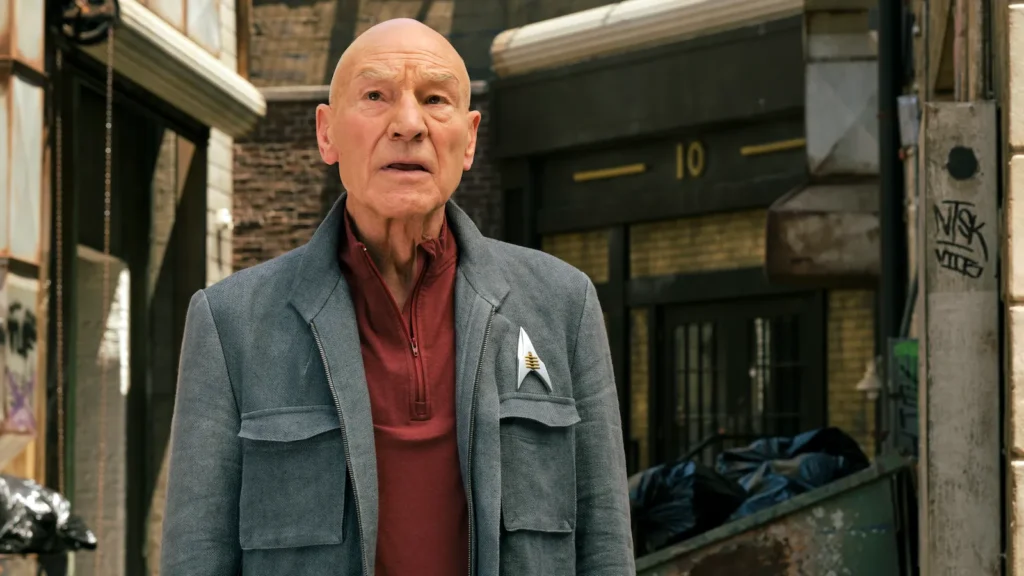
Then came four films: Generations (1994), First Contact (1996), probably the best of them, Insurrection (1998) and Nemesis (2002). Then, when everyone thought the chapter was closed, Stewart put the uniform back on in 2020 for Star Trek: Picard. Three seasons telling the story of an ageing admiral haunted by his ghosts, ending with a final season that felt like a family reunion with the crew of The Next Generation. A farewell fans no longer dared to hope for.
Charles Xavier, mentor to the mutants
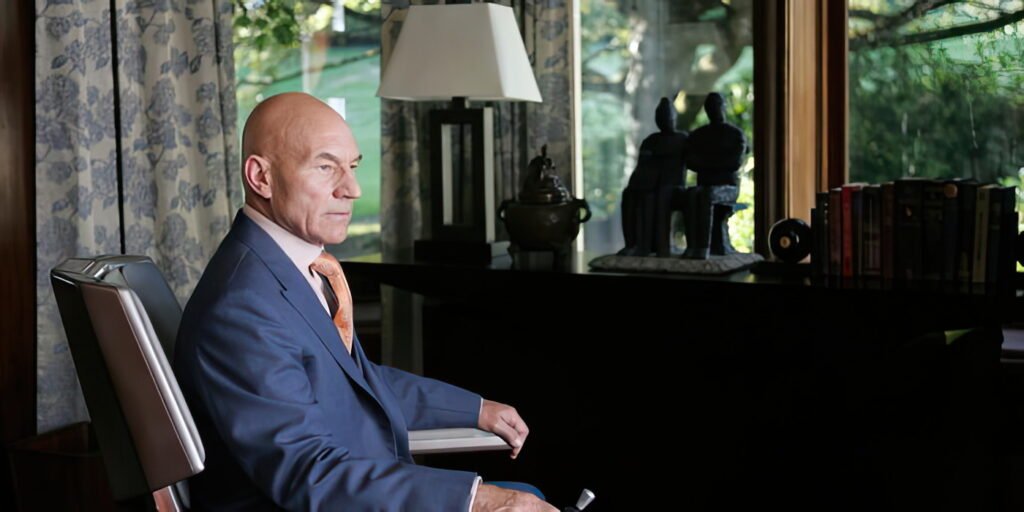
In 2000, Bryan Singer gave him Professor Charles Xavier’s wheelchair in X-Men. Opposite him, Ian McKellen played Magneto. The two old friends from the RSC became on-screen brothers turned enemies, two opposing visions of how humans and mutants might live together. Their chemistry fed every scene and gave superhero films a depth unheard of at the time.
Then came X2 (2003), X-Men: The Last Stand (2006) and X-Men: Days of Future Past (2014), in which his Xavier meets his younger self, played by James McAvoy. But it was in Logan (2017) that he gave his most heartbreaking performance: a frail, lost, ninety-year-old Xavier, cared for by an exhausted Wolverine. A performance of immense humanity, praised far beyond the usual superhero audience.
Marvel brought him back in 2022 for a much-talked-about appearance in Doctor Strange in the Multiverse of Madness, and then for Avengers: Doomsday, due on 18 December 2026. It will be the eighth and final time he plays Charles Xavier. An appearance that will now feel like a tribute.
The other roles that matter
Reducing Patrick Stewart to Picard and Xavier would be unfair. His career is full of roles that left their mark on audiences:
- Ebenezer Scrooge: from the late 1980s, he performed Dickens’s A Christmas Carol as a one-man show, playing dozens of characters on his own. A show he would revive for decades.
- Captain Ahab: in 1998, he hunted the white whale in a television adaptation of Moby Dick.
- Macbeth: his chilling version, set in a totalitarian regime, earned him a Tony Award nomination in 2008.
- Claudius: opposite David Tennant’s Hamlet, he won another Laurence Olivier Award in 2009.
- Waiting for Godot: with Ian McKellen, once again, in London and then on Broadway in 2013. Their playful strolls around New York are still fondly remembered.
- Avery Bullock: for more than twenty years, he voiced the eccentric CIA boss in the animated series American Dad!, proof of a sense of self-mockery that never left him.
We should also mention the Grammy he won in 1995 for a spoken word album for children, and that unexpected ritual of 2020: during lockdown, he read a Shakespeare sonnet every day on social media for hundreds of thousands of followers. This very year, he had recorded all 154 sonnets as an audiobook, complete with his own commentary.
The man behind the captain
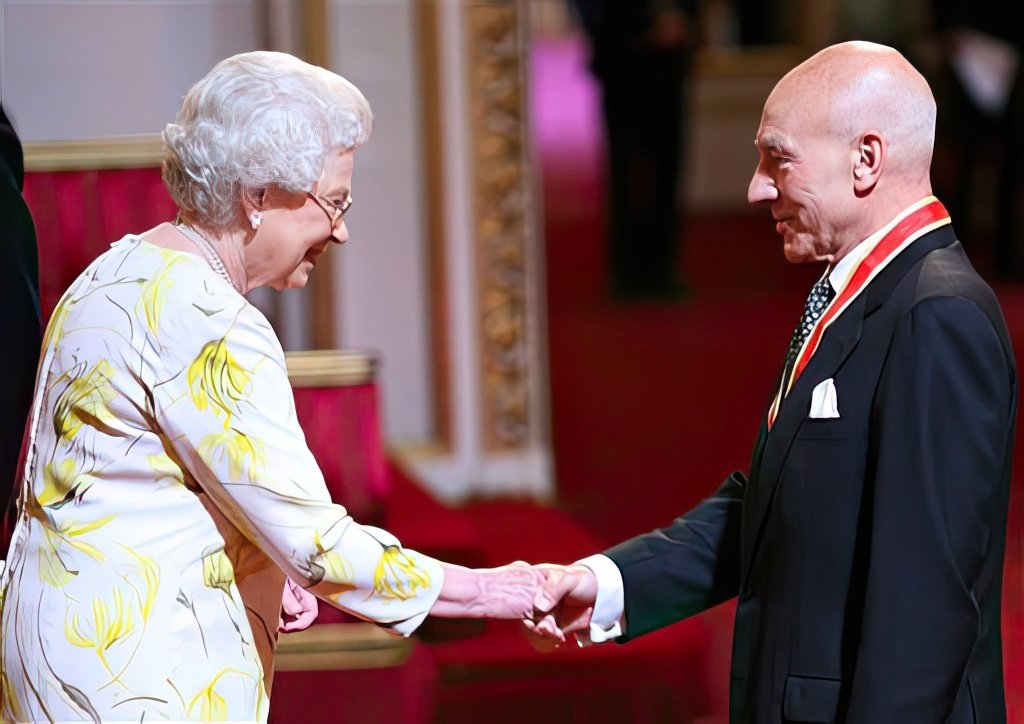
Made an Officer of the Order of the British Empire in 2001, Patrick Stewart was knighted in 2010 by Queen Elizabeth II for services to drama. The boy from Mirfield became Sir Patrick. Yet, according to Ian McKellen, the honour he was proudest of lay elsewhere: serving as Chancellor of the University of Huddersfield, in his native Yorkshire, from 2004 to 2015.
Away from the set, he put his fame at the service of his convictions: the fight against domestic violence, support for veterans, the welcoming of refugees, human rights and animal welfare. Many will remember Ginger, the pit bull he fostered, whose photos went around the world.
In his private life, he married Sheila Falconer in 1966, with whom he had two children, Daniel and Sophia. After their divorce in 1990, he was briefly married to the producer Wendy Neuss, before meeting the singer Sunny Ozell. They married in 2013, in a ceremony officiated by… Ian McKellen. In 2023, he published his memoir, Making It So, a nod to Picard’s famous order, which made the New York Times best-seller list.
A flood of tributes
Since the announcement of his death, tributes have poured in from all sides. William Shatner, Captain Kirk himself, hailed a friend and a magnificent actor, summing up in one sentence what his successor represented: “Captain Picard stood for the best of us.” George Takei recalled that he took the Enterprise where it had never gone before, and Jonathan Frakes, his loyal “Number One”, said goodbye to his friend.
On the mutant side, Hugh Jackman mourned one of the greats of stage and screen, and a dear friend. Marvel Studios and its president Kevin Feige spoke of a singular talent who defined Charles Xavier for generations, with a formidable sense of humour on set. Ian McKellen, finally, saw in him the most respected and beloved actor of his generation. The Royal Shakespeare Company, which watched him grow, saluted a colossus of both stage and screen.
There is something deeply fitting about Patrick Stewart’s journey. That of a child who grew up in fear and spent his life playing men of wisdom. Of an actor trained in the greatest texts of the repertoire who never looked down on science fiction. Of a captain who, episode after episode, showed us that one could command without crushing, explore without conquering, and doubt without faltering.
The bridge is silent, the captain’s chair is empty. But somewhere between the stars and the stage, Jean-Luc Picard is still looking straight ahead. Thank you for everything, Sir Patrick. And one last time: engage.


Comments 0
No comments yet: start the conversation!
Your Discord name and picture will sign your comment. Be courteous: inappropriate comments are removed.