

Before Star Citizen: the man behind Wing Commander
Chris Roberts was born in 1968 in Redwood City, California, to a British father and an American mother, and grew up in Manchester. As a teenager he published his first games on the BBC Micro, among them Wizadore and Stryker’s Run.
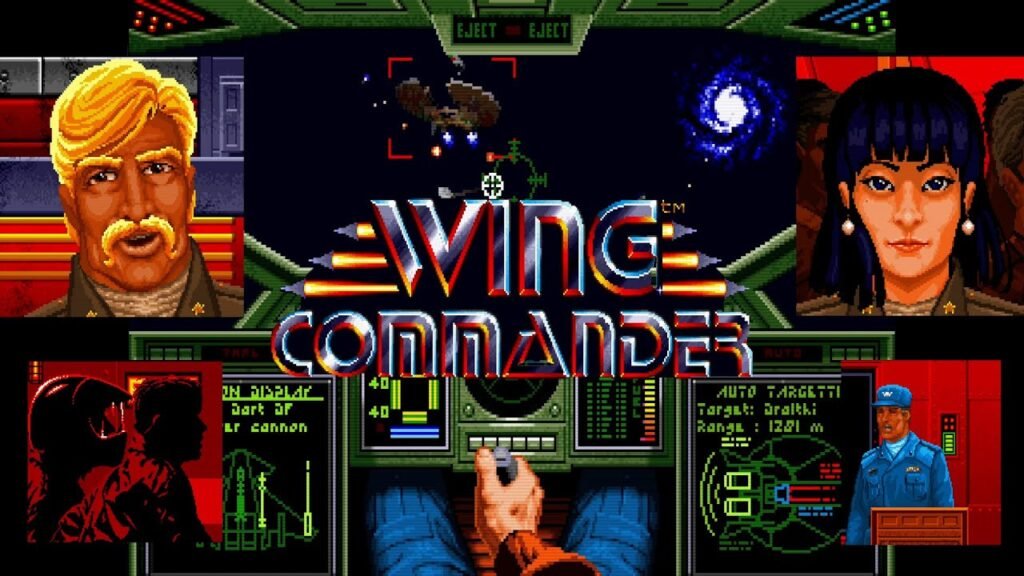
In 1987 he joined Origin Systems in Austin, Texas, the home of the Ultima series. There he made Times of Lore (1988), then Wing Commander (1990), a space combat simulator that became the publisher’s biggest hit. The formula comes down to one idea: sit the player in a cockpit and bring cinema into the game.
Roberts pushed that logic all the way. For Wing Commander III (1994) and Wing Commander IV (1996), he directed the live-action sequences himself, with Mark Hamill in the lead. In between, Privateer (1993), produced by his brother Erin, added trading and the freedom to go wherever you liked to the combat. Both halves of the future Star Citizen were already there.
Digital Anvil, or the dress rehearsal
In 1996, Roberts left Origin. He said he could no longer stand very large teams, nor Electronic Arts’ refusal to fund anything other than sequels. He founded Digital Anvil in Austin with Erin Roberts and Tony Zurovec, then signed a publishing deal with Microsoft in 1997.
The studio wanted to make both games and films. The Wing Commander feature film (1999), directed by Roberts, was a critical and commercial failure. On the games side, Starlancer shipped in 2000, but the big project was Freelancer: an open, living universe, promised for 2001.
It would not keep to that schedule. Microsoft bought Digital Anvil in late 2000; Roberts gave up directing the game and stayed on for a while as a consultant. Freelancer came out in 2003, with noticeably less in it than originally planned. That precedent, an ambition too broad for its schedule and then taken in hand by the publisher, explains many of the choices that followed.
The Hollywood interlude
Roberts moved to Los Angeles and founded Ascendant Pictures in 2002. There he produced, among others, Lord of War, Lucky Number Slevin and Outlander. Those films relied heavily on a German tax scheme that was closed in 2006; the company was taken over in 2010 by Bigfoot Entertainment.
He came away from that decade with two things: a taste for prestigious casts and a business partner, the German lawyer Ortwin Freyermuth, a specialist in media law.
2010-2012: the secret comeback
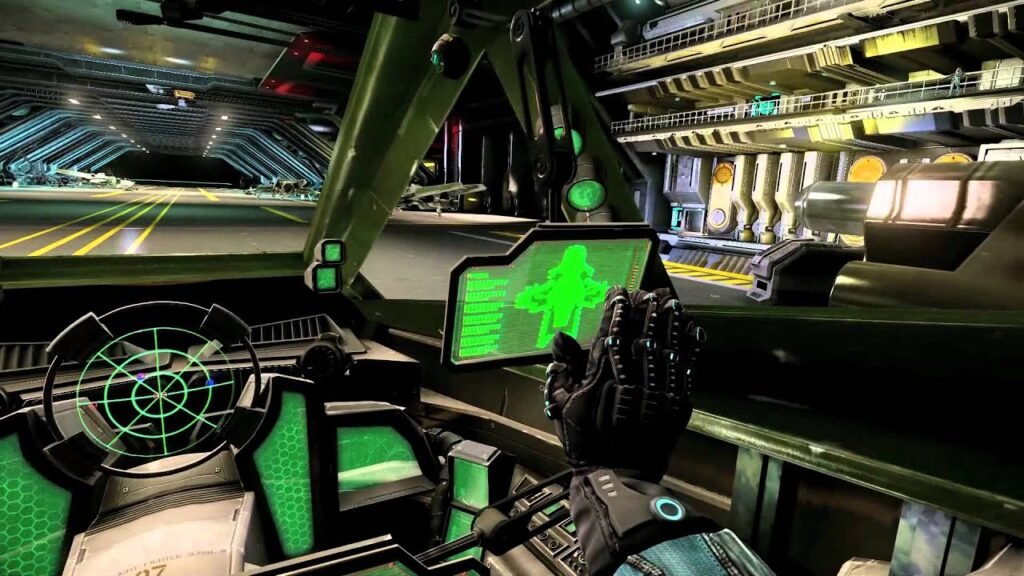
Pre-production on Star Citizen began in 2010 and production in 2011, on CryEngine 3 from the German company Crytek. Roberts did not have a studio yet. He put contractors to work, including CGBot, Rmory, VoidAlpha and Quebec’s Behaviour Interactive, on a prototype and concept art.
The original aim was a conventional one: show that prototype to private investors. In early 2012, the success of Double Fine’s Kickstarter campaign changed the plan. Roberts decided to go straight to the players.
Cloud Imperium Games (CIG) was set up for that purpose by three founders: Chris Roberts, his wife Sandi Gardiner, in charge of marketing, and Ortwin Freyermuth, who became the company’s in-house lawyer. The group itself dates its founding to April 2012. Ben Lesnick and David Swofford, who came from the Wing Commander world and from Origin, joined the team to build the campaign.
The website took the name of a fictional shipbuilder from the game, Roberts Space Industries (RSI). That choice already says the essential thing: the project would be sold from inside its own universe.
October 10, 2012: the Austin announcement
Star Citizen was unveiled on October 10, 2012 at GDC Online in Austin. Roberts showed his prototype running in real time and opened fundraising on his own website, which promptly went down under the traffic. A Kickstarter campaign was added on October 18 to absorb the demand.
The promise fits in one line from the Kickstarter page: everything that made Wing Commander and Privateer / Freelancer special. In detail:
- a story-driven single-player campaign, Squadron 42, playable in co-op;
- a persistent online universe, hosted by the studio;
- private servers open to mods;
- no subscription and no pay-to-win;
- a game designed for high-end PCs, joysticks and virtual reality.
Release was announced for November 2014. Roberts reckoned at the time that three years of development in total was the ideal length, and that beyond that a project would “begin to get stale”.
When it closed in November 2012, the campaign had brought in 6.2 million dollars, a little over 2 million of it through Kickstarter. That was a record for a video game. But the fundraising did not stop: the site went on selling ships, and the stretch goals kept coming.
By mid-2013, with 15 million dollars, Star Citizen had become the best-funded project in crowdfunding history. In October 2013 it passed 23 million, the threshold at which Roberts had said he could do without any outside investor. In 2014, Guinness recorded 39.7 million dollars.
Each stretch goal added promises: new ships, new star systems, a first-person shooter module. The game of 2012 and the game of 2014 were already no longer the same project.
Building a studio and a game at the same time
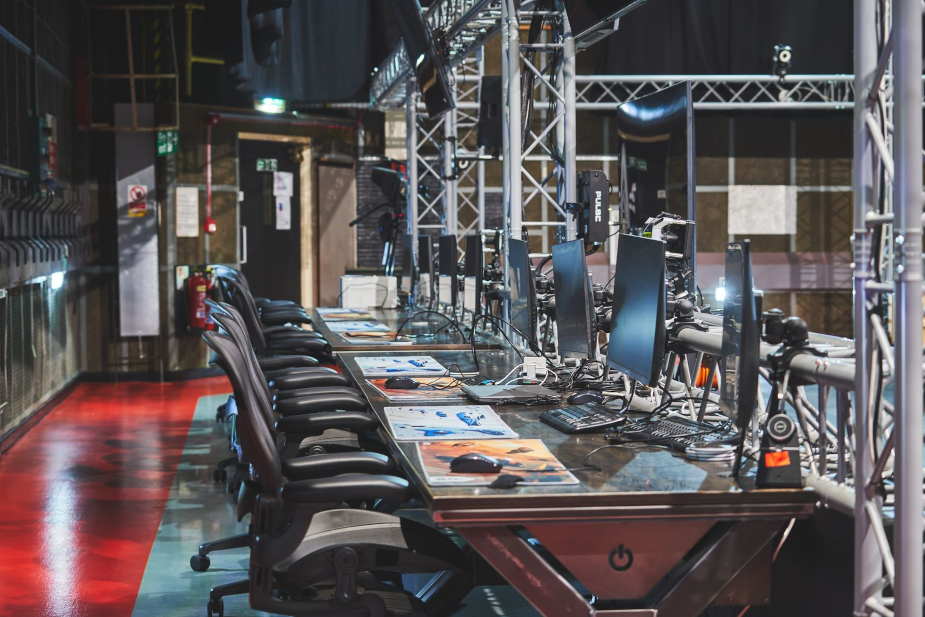
Cloud Imperium Games had to hire, open offices and produce a game all at once, with no pre-existing team. That is what sets the project apart, and one of the causes of its delays.
The first offices opened in Austin and in Santa Monica, near Los Angeles. In 2013, Erin Roberts joined his brother and founded Foundry 42 in Wilmslow, on the outskirts of Manchester, to lead Squadron 42. In 2015, a studio opened in Frankfurt around former Crytek engineers, the people best placed to transform CryEngine.
The rest was outsourced at first: Behaviour in Montreal, Turbulent for the web platform, IllFonic in Colorado for the Star Marine shooter module. That scattered setup proved costly. The environments IllFonic produced were not built to the same scale as the rest of the game; the contract was ended in August 2015 and the module was restarted in-house.
CIG drew a lasting lesson from it and brought almost everything in-house. The centre of gravity shifted towards Europe. In 2022, the British studio left Wilmslow for a new building in central Manchester, which became the group’s headquarters. Turbulent was acquired in July 2023, bringing headcount to 1,110.
| Studio | Opened | Main role |
|---|---|---|
| Manchester (formerly Wilmslow), United Kingdom | 2013, as Foundry 42 | Group headquarters; Squadron 42, ships, audio, user interface |
| Frankfurt, Germany | 2015 | StarEngine, tools, AI, cinematics, procedural planets |
| Austin, United States | 2012-2013 | The original US studio, and the only one still active in the United States |
| Montreal, Canada | Turbulent acquired in 2023, partly renamed CIG Montreal in 2025 | Web platform, star systems |
| Derby, United Kingdom | 2016 | Facial capture pipeline |
| Los Angeles, United States | 2012-2013, closed in 2025 | Original headquarters; teams reassigned to the other sites |
The reverse movement began in 2024. A restructuring tied to the consolidation in Manchester led to the departure of senior staff, including live game director Todd Papy, and to layoffs. The Los Angeles office closed in 2025. At the end of 2024, the group reported 1,031 employees.
The business model: selling ships to build the universe
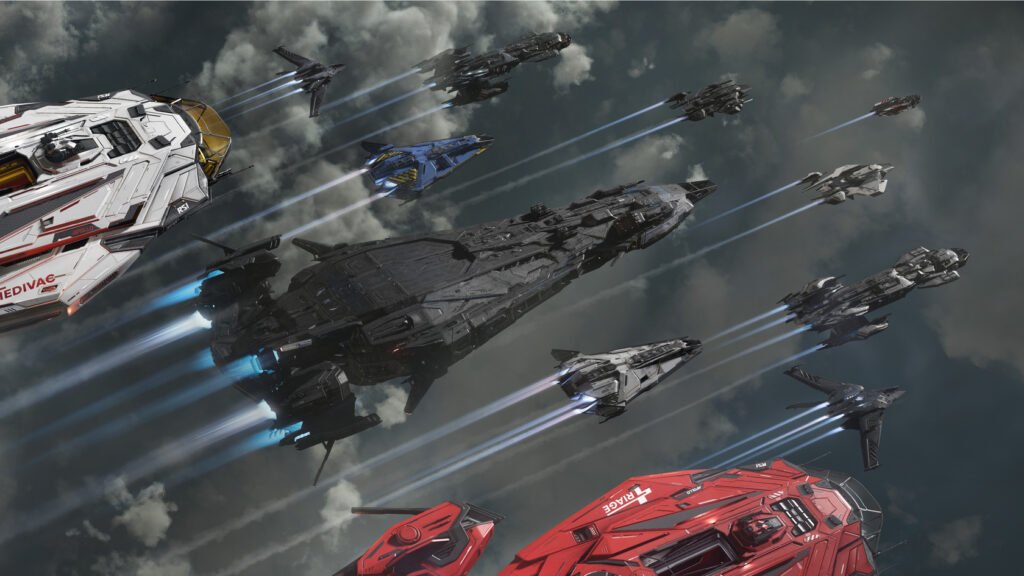
Star Citizen is funded almost entirely by its players, through the sale of game packages and ships. The first playable package in 2012 cost 30 dollars, Aurora ship included. At the other end of the scale, a “Legatus” pack was offered for 27,000 dollars in 2018, and the Odin battlecruiser, still only a concept, went on sale at around 5,000 dollars in May 2026.
The mechanism is well oiled. A ship is first sold on the strength of illustrations, months or years before it can be flown. Sales are concentrated around a few annual events, including the November anniversary sale. CIG says that everything, apart from certain cosmetic items and lifetime insurance, will be earnable by playing.
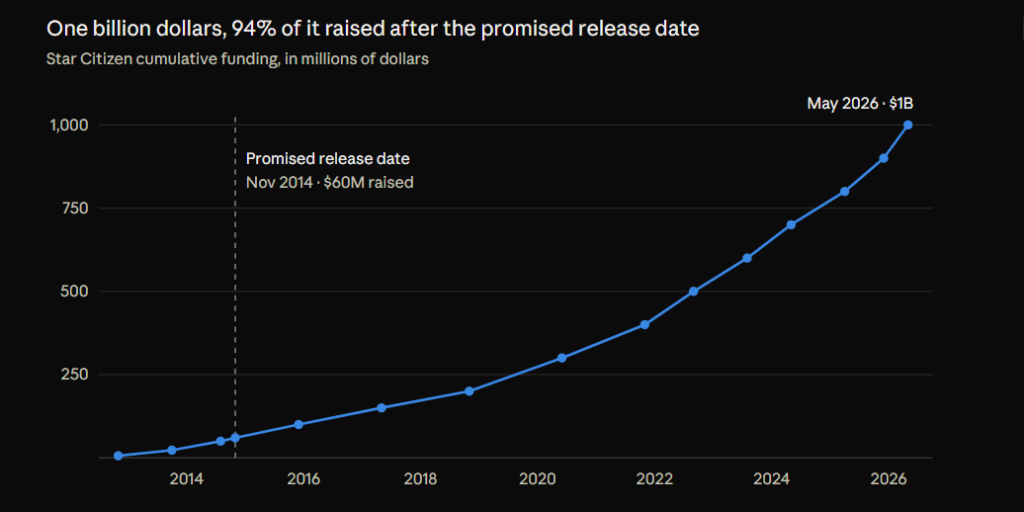
It took a little over three years to raise the first 100 million, and six months for the latest 100. Since late 2017, the counter has added crowdfunding and early access sales together without telling them apart.
Private investors, all the same
In 2013, Roberts maintained that beyond 23 million the project would do without investors. In December 2018, billionaire Clive Calder and his son Keith nonetheless acquired 10% of CIG for 46 million dollars, a valuation of 460 million, and joined the board. A further 17.25 million followed in March 2020.
That money comes with strings attached. The 2022 UK accounts describe a put option that lets the investors get their stake back with interest, during windows set in 2024, 2025 and 2028.
Where the money goes
The accounts published in the United Kingdom give an order of magnitude: 193 million dollars spent between 2012 and 2017, with 14 million in reserve. So CIG spends roughly what it takes in. The studio has no war chest; each year it depends on that year’s sales.
What the model is criticised for
- Pay-to-win. Powerful ships can be bought with real money, and the cap on purchasable in-game currency was lifted in 2018.
- Selling promises. Plots of land were sold in 2017 when the mechanic did not exist. In 2021, the UK advertising regulator (ASA) required the studio to make clear that “concept” ships are not yet playable.
- The grey market. As early as 2014, Eurogamer described limited-edition ships being resold between players through middlemen.
A game delivered in pieces
Unable to release the game, CIG has published its parts one by one. This “open”, module-by-module development has become the project’s trademark: backers test what exists, and fund what comes next.
The Hangar (August 2013). The first deliverable: you walk around the ships you have bought. Nothing flies yet.
Arena Commander (June 2014). A space combat simulator, presented as a game within the game. Planned for December 2013, it arrived six months late and reached version 1.0 in December 2014, the month the complete game was supposed to ship.
Star Marine (December 2016). The on-foot shooter module, announced for 2015, came out more than a year late after the split with IllFonic.
Alpha 2.0 (December 2015). The first piece of persistent universe. Flight, on-foot combat and multi-crew ships finally coexisted in one shared space.
Alpha 3.0 (December 2017). The first moons you can land on without a loading screen. Announced for late 2016 and delivered a year later, this version was likened by the studio to an early access release. CIG then adopted a public roadmap and a quarterly update cadence.
The Stanton system (2018-2023). For six years the game filled out within a single star system: planets, cities, mining, caves, a law system. Update 3.18, in March 2023, caused major outages, a sign of technology that remained fragile.
Alpha 4.0 (December 2024). A second system, Pyro, linked to Stanton by a jump point. Server meshing raised the capacity of a shared universe from roughly 100 to 500 players. A third system, Nyx, followed with Alpha 4.4.
The gap with the original promise remains considerable. In October 2024, CIG defined its version 1.0 around five star systems, a long way from the hundred or so mentioned in the campaign’s stretch goals. In August 2025, Roberts was aiming to release that 1.0 in 2027 or 2028.
Squadron 42: the single-player campaign, from 2014 to 2027
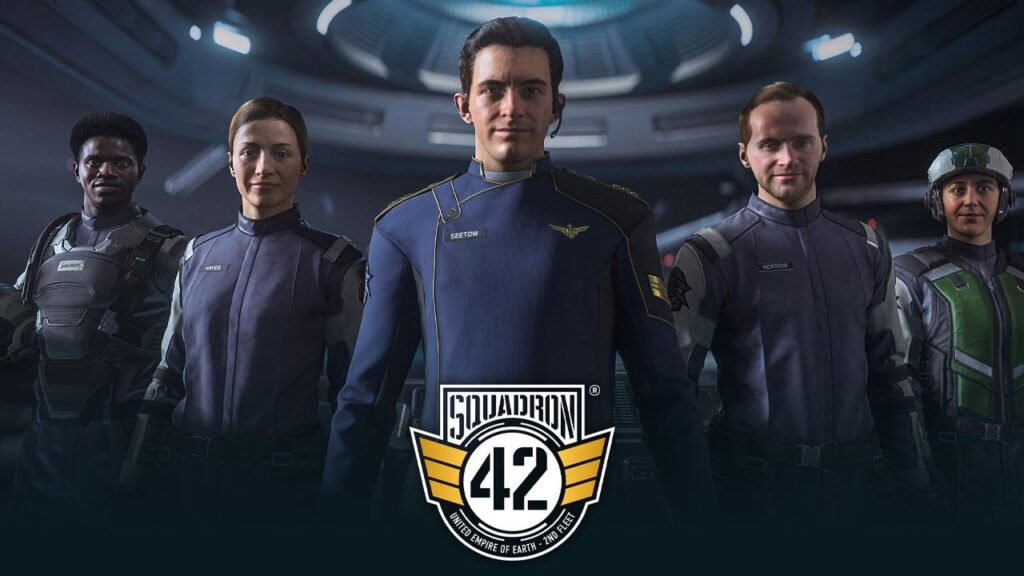
Squadron 42 was meant to come out in November 2014; it is now announced for the second quarter of 2027. Yet it is the studio’s most advanced product, and the first one it actually intends to put on sale.
In the 2012 campaign it was the single-player side of Star Citizen, presented as the spiritual successor to Wing Commander. The player enlists in the navy of the United Empire of Earth and lives through a scripted military campaign. Production was entrusted to Foundry 42, under Erin Roberts.
The flood of money changed its nature. In 2014-2015 the campaign became a game in its own right, conceived as an interactive film. The cast revealed from October 2015 onwards brings together Gary Oldman, Mark Hamill, Gillian Anderson, Mark Strong, Andy Serkis, Liam Cunningham, John Rhys-Davies, and later Henry Cavill and Ben Mendelsohn. The announced length went from around twenty hours for a first episode to more than forty hours.
| Announced | Target release |
|---|---|
| October 2012 | November 2014 |
| October 2015 | 2016 |
| October 2016 | Postponed with no date |
| 2018-2019 | Beta in 2020, pushed back twice during the year |
| December 2020 | No more dates or public demonstrations |
| October 2024 | 2026 |
| August 2026 | Second quarter of 2027 |
The December 2020 turning point is worth noting. Roberts decided then to show and promise nothing more until the game was on its home stretch. The silence lasted nearly three years.
In October 2023, CIG declared the game feature complete and in its polishing phase. A year later, a long gameplay sequence was shown at CitizenCon, with a 2026 release. In late 2025, the studio said that every chapter was playable internally.
On August 27, 2026 came a new letter from Chris Roberts: the release slips to the second quarter of 2027. The reason given is commercial. GTA VI comes out on November 19, 2026, and the studio does not want to launch its game in that window. The argument was met with scepticism, since GTA VI is coming to consoles first and Squadron 42 is planned for PC only.
In return, a small group of original backers and content creators is due to play Squadron 42 on October 9 and 10, 2026, in Manchester. It will be the first announced hands-on outside the studio.
The technology bets
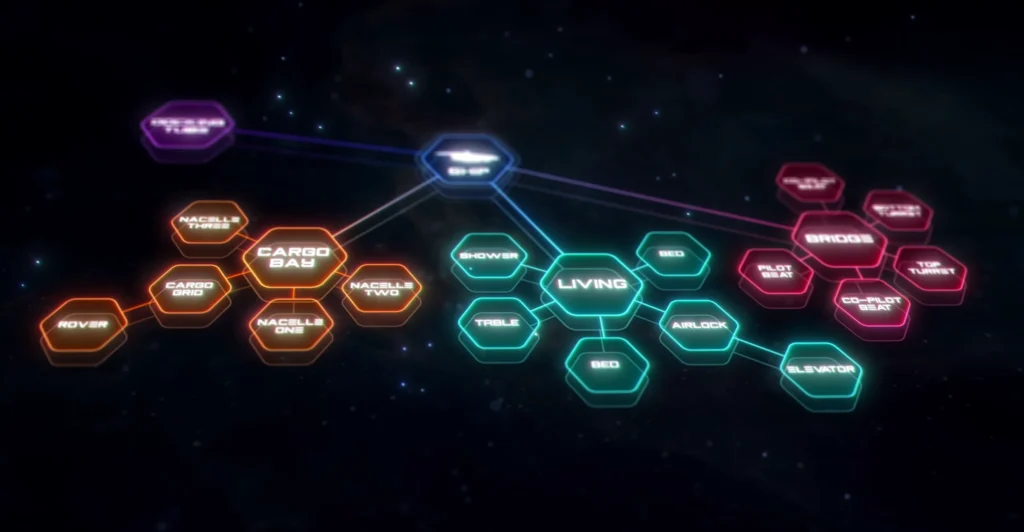
Most of the delay comes down to one technical choice: a seamless universe, with no loading screens, where you go from a ship’s corridor to the surface of a planet at the level of detail of a shooter. No off-the-shelf engine could do that in 2012.
An engine turned away from its purpose. CryEngine 3 was chosen in 2011 for its visual quality. It was designed for levels a few kilometres across, not for a solar system. The Frankfurt engineers rewrote its foundations, starting with the move to 64-bit coordinates, which is indispensable at those scales.
The 2016 engine change. In December 2016, CIG announced out of the blue that it was migrating to Lumberyard, Amazon’s engine, itself derived from CryEngine. Roberts cited integration with Amazon Web Services’ online services and with Twitch. The heavily modified in-house version now goes by the name StarEngine.
Procedural planets. Delivered with Alpha 3.0 in late 2017, they make it possible to descend from orbit to the ground in one continuous motion. This building block was not in the 2012 project; it did a great deal to change its scale.
Streaming on the fly. The universe fits neither in the memory of the player’s PC nor in the server’s. The technique known as Object Container Streaming solved the problem on the client side in late 2018, then on the server side in late 2019. The studio spoke at the time of one of its biggest technical milestones.
Server meshing. This is the piece that was awaited for ten years: several servers share a single universe, and players move from one to the other without seeing it. The first, static version arrived with Alpha 4.0 in December 2024 and targets 500 players per universe. A crash now affects only the area handled by the server concerned.
All this work serves two games at once. Squadron 42 and Star Citizen share the same engine, which explains why a delay on one has so often dragged the other along with it.
Fourteen years of controversy
Star Citizen has been divisive since 2015, the point at which the game should have been out and its scope had visibly changed. The criticism falls into four areas.
Delays and a ballooning project
The central charge is feature creep: every funding milestone added promises, and every promise added time. The specialist press was talking about vaporware as early as 2016, the year Wired gave it its award in that category. The comparison with Elite: Dangerous, announced around the same time and released in 2014, comes up constantly.
The public clashes
In July 2015, developer Derek Smart, an early backer, claimed that the game could never be made as sold. CIG refunded him, closed his account and called his accusations defamatory.
In the autumn of 2015, The Escapist published two investigations based on anonymous sources describing a project in trouble. Chris Roberts replied with a scathing letter and the studio threatened legal action. The dispute ended in early 2017 with both sides withdrawing their statements. A five-part series from Kotaku UK followed in 2016, and a long Forbes investigation in May 2019.
Refunds
In June 2016, CIG changed its terms of service. Until then, a backer could be refunded if the game had not been delivered eighteen months after the planned date; from then on, only if the project was abandoned.
Several cases drew media attention. In 2018, a backer claiming 4,496 dollars lost in a California small claims court. According to Forbes, the US Federal Trade Commission (FTC) had by then received 129 complaints about the studio.
The Crytek lawsuit
In December 2017, Crytek sued CIG for copyright infringement and breach of contract. The maker of CryEngine accused it in particular of using its engine for two games instead of one and of having moved to Amazon. Several of the claims were dismissed by the judge in 2018, and the two companies reached a confidential settlement in February 2020. CIG acquired a CryEngine licence that same year.
Working conditions
In October 2024, Insider Gaming reported that the studio had imposed two weeks of seven-day working ahead of CitizenCon. The promised time off in lieu was conditional on still being employed when Squadron 42 is released. The episode came after the layoffs earlier in the year.
What the project’s defenders say
Supporters of Star Citizen put forward three arguments. The game exists and can be played, even unfinished. Few studios document their work as thoroughly, with monthly reports, weekly shows and a public roadmap. And the money funds visible development rather than dividends, even though the UK accounts revealed around one million pounds paid to shareholders in 2020.
October 2026: where do things stand?
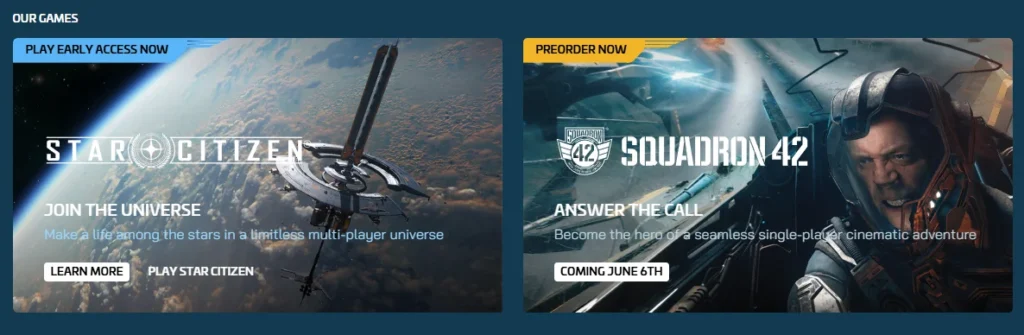
Fourteen years after the Austin announcement, neither game has been released, but both are closer to a commercial version than they have ever been.
- The money. The counter passed one billion dollars on May 24, 2026, driven by the sale of the Odin battlecruiser. The latest 100 million was raised in six months.
- The persistent universe. The online game is at Alpha 4.10, with three playable star systems: Stanton, Pyro and Nyx. Version 1.0 is aiming for five, in 2027 or 2028 according to Chris Roberts.
- Squadron 42. Release targeted for the second quarter of 2027, on PC. The first hands-on by invited players is scheduled for October 9 and 10, 2026.
- The studio. Just over 1,000 employees at the end of 2024, a headquarters in Manchester, and four other sites in Frankfurt, Austin, Montreal and Derby. The original Los Angeles office closed in 2025.
What happens next depends largely on Squadron 42. It will be Cloud Imperium Games’ first finished product, and therefore the first that can be judged as a game rather than as a promise. Roberts was explaining as early as 2017 that its revenue could fund the completion of Star Citizen.
A good single-player campaign would vindicate the method in hindsight: the engine, the tools and the teams exist, and the rest will follow. A failure would raise a question the studio has always been able to put off: how patient the people funding it really are.
Timeline
| Date | Event |
|---|---|
| 1968 | Chris Roberts is born in California; he grows up in Manchester |
| 1987 | Joins Origin Systems in Austin |
| 1990 | Wing Commander is released |
| 1996 | Leaves Origin and founds Digital Anvil |
| 2000 | Microsoft buys Digital Anvil; Roberts leaves the studio |
| 2002-2010 | Producer in Hollywood with Ascendant Pictures |
| 2003 | Freelancer is released, finished without him |
| 2010-2011 | Pre-production, then a Star Citizen prototype on CryEngine 3 |
| April 2012 | Cloud Imperium Games is founded |
| October 10, 2012 | Announcement at GDC Online in Austin and start of fundraising |
| November 19, 2012 | End of the campaign: 6.2 million dollars |
| August 2013 | Hangar module, the first deliverable |
| September 2013 | Foundry 42 is set up in the United Kingdom, led by Erin Roberts |
| June 2014 | Arena Commander module |
| November 2014 | Release date promised during the campaign |
| 2015 | Frankfurt opens; Squadron 42 cast revealed; Alpha 2.0; the 100 million mark |
| December 2016 | Move to the Lumberyard engine; Star Marine module |
| December 2017 | Alpha 3.0 and the first moons; Crytek files suit |
| December 2018 | Clive Calder takes a stake for 46 million dollars |
| February 2020 | Out-of-court settlement with Crytek |
| December 2020 | No more announced date for Squadron 42 |
| 2022 | New headquarters in Manchester; the 500 million mark |
| July 2023 | Acquisition of Turbulent |
| October 2023 | Squadron 42 declared feature complete |
| December 2024 | Alpha 4.0: the Pyro system and server meshing |
| 2025 | The Los Angeles office closes |
| May 24, 2026 | The one billion dollar mark |
| August 27, 2026 | Squadron 42 pushed back to the second quarter of 2027 |
To join the Star Citizen universe:
How will your journey begin?
Mining, hauling, combat, and more. Explore our Starter Packs and begin your adventure in the universe. All packs include the Star Citizen game.


Comments 0
No comments yet: start the conversation!
Your Discord name and picture will sign your comment. Be courteous: inappropriate comments are removed.